The Middle Land

The Expansion of the Cosmos: Dark Matter vs Dark Energy

44 Views

By Patricia Kingswell

Add Your Heading Text Here

In 1907, Albert Einstein theorised that the acceleration due to motion and the acceleration due to gravity were indistinguishable, leading him to solve for cosmology. He presented the Einstein field equations that tried to explain how matter and energy warp the fabric of space and time to create the force of gravity. At the time, astronomers believed the universe to be a constant that was fixed in size.

 In 1916, American astronomer Vestro Slipher provided the first empirical basis for the expansion of the universe, when he discovered galactic redshifts. After measuring the velocities to nearby galaxies, he puzzled over the big mystery and concluded that they must all be moving away from the Earth.

 When Einstein, in 1917, applied his new ideas of general relativity to the universe as a whole, his theory surprisingly predicted that the universe had to be in dynamic motion—either expanding or contracting. To force the universe to be static, Einstein tacked on what he called the “cosmological constant”—something he later considered to be his biggest blunder.

 Fast forward a decade to 1929—Edwin Hubble used the brightest stars to measure the distances to the nearest galaxies, basing his methods on Isacc Newton’s Inverse-square Law that would allow you to assume a light to be four times brighter at half the distance to the observer. “The universe is expanding,” concluded Hubble, when assuming that the brightest stars are all the same brightness. He believed that the further the galaxy was, the faster it was moving away from us and presented the Hubble Constant—a chart that showed a constant between distance and speed.

The Universe expands like a balloon. A simple analogy of Hubble’s Law

 Later, astronomer Fritz Zwicky and his team began looking at supernovae through wide-angle telescopes and by 1968, created their version of Hubble’s diagram that showed a constant between distance and redshift. They believed supernovae were all identical—a basis later discovered to be false by a team of researchers.

 So in 1994, Havard Mario Hamuy and his team—who discovered 29 different supernovae—created a new version of Hubble’s diagram, plotting distance to redshift. A competition began between two teams—The Supernova Cosmology Project and The High-Z Team—observing supernovae to understand the bigger universe.

 In 1997, Nobel Laureate Brian Schmidt and his High-Z team revealed a diagram that plotted distance to redshift of supernovae that found the total sum of universal mass to be negative, which meant acceleration—it predicted an infinite universe with a geometry-curvature that curves outwards. A great mystery was born—what was this thing that appeared to be pushing on the universe? Both teams published the same “crazy result” in 1998.

 The researchers came back full circle to Einstein’s cosmological constant and his theory of general relativity to explain this mysterious material that seemingly makes gravity push, not pull—or overcomes gravity. They named this substance “dark energy” meaning, “energy we don’t understand very well”—matter that they believe to be some undiscovered particle that, like a neutrino, can pass through Earth and is invisible.

 In their question to understand the overall universe and it’s geometric shape, cosmologists had three possible shapes: a finite universe that was a closed sphere; a stable universe that was flat; or an infinite universe that was an open concave. Further research concluded that there was only 27% of this dark matter (pulling force) that would be needed for the universe to be flat. Their calculations using sound waves also determined the same results—that there was 73% black energy (pushing force).

 “The reality is a mess,” says Schmidt; 4% of the universe as atoms, 24% dark matter (pulling), and 73% mystery matter that’s pushing the universe apart. It presents a reality where 97% of the universe is unknown to humans.

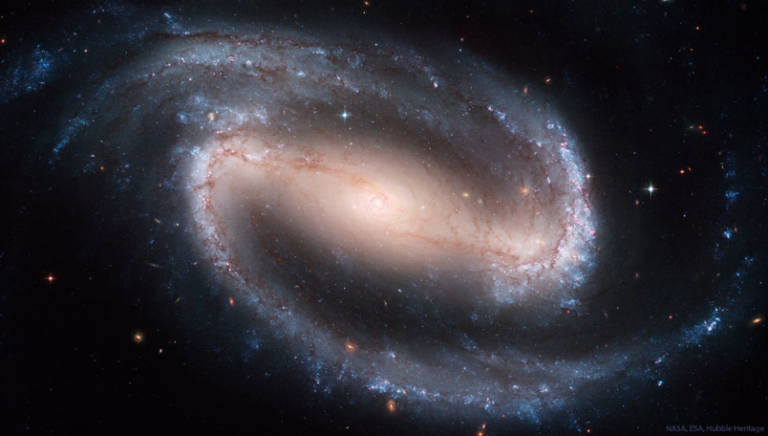
Dark matter spacing of stars and galaxies. (Image: © Rik Trottier | Dreamstime.com)

 Cosmologists are now looking into what they call “a battle for domination of the universe: dark energy versus dark matter.” They understand the dark matter’s density and effect as getting smaller as the universe expands. On the contrary, the dark energy gets created along with the created cosmic space, so this energy is thought to become stronger over time, as it is tied to the universal space itself, according to Schmidt.

 “The future of the universe? The future of the universe seems to be dark energy,” concludes Schmidt, who says the creation of space is happening even faster than light can travel. The only part of the universe that doesn’t seem to be expanding is the Earth and the Milky Way, according to researchers.

 “But the reality is, until we understand what’s accelerating the cosmos, anything is possible,” says Schmidt.


 

Tag

SubscribeNewsletter@2x
Refreshing and Insights
at No Cost to You!

Cancel anytime

Leave a Reply

One of the most remarkable examples of medieval Chinese Buddhist art is

Back-to-back monster winters (1867 and 1868) paralyzed railroad construction over Donner Pass.

When a Speech Nearly Never Happened: The U.N. Session That Drew Unexpected

Margaret Thatcher (1925–2013), often remembered as the “Iron Lady,” remains one of

Art has the incredible power to evoke emotions, tell stories, and transport

“Painting has been my passion since childhood, and my parents were always

Curator Laura Llewellyn works with art handlers to arrange and hang a

A mother asks what she should say to her 9-year-old daughter who

Long before the rise of communism, photographers captured a China that few

Across the United States, some of the country’s most memorable destinations are

The Eiffel Tower in Paris. The Clock Tower of London. The Busy

Small old villages in United Kingdom are known for their historic charm,

From distant worlds at the edge of the Solar System to colossal

The Eiffel Tower in Paris. The Clock Tower of London. The Busy

The universe is far stranger — and more beautiful — than imagination

In what would have marked Queen Elizabeth II’s 100th birthday, King Charles

Did Ancient China Discover America Before Columbus?

A Former Flight Attendant Recounts Tiananmen Massacre in Beijing (Audio)

The Iron Lady’s Secret: Margaret Thatcher Leadership Advice

When Poetry Becomes a Cry of the Soul: The Meaning of “Un dì all’azzurro spazio” — and Franco Corelli’s Legendary Performance

What did a modern kitchen look like in the early 1950s? A

Let us take the three worst and most striking characteristics, patience, indifference

Psychology says the 1960s and 70s accidentally produced one of the most

I. Mellowness “CHARACTER” is a typically English word. Apart from the English,

In the dimly lit hall of the Stanton Center in Monterey, CA,

Margaret Thatcher (1925–2013), often remembered as the “Iron Lady,” remains one of

Few events of the late 20th century continue to provoke as much

[totalpoll id="62479"]
Cancel anytime

Contact us

The Middle Land

100 Wilshire Blvd., Suite 700 Santa Monica, CA 90401

Login Now

Sign in to your account

Don’t have an account? Sign Up

Don't have an account?

Sign up

Receive free monthly subscription & other benefits

Already have an account? Sign in

Already have an account?

To Editor

One of the most remarkable examples of medieval Chinese Buddhist art is

Back-to-back monster winters (1867 and 1868) paralyzed railroad construction over Donner Pass.

When a Speech Nearly Never Happened: The U.N. Session That Drew Unexpected

Margaret Thatcher (1925–2013), often remembered as the “Iron Lady,” remains one of

Art has the incredible power to evoke emotions, tell stories, and transport

“Painting has been my passion since childhood, and my parents were always

Curator Laura Llewellyn works with art handlers to arrange and hang a

A mother asks what she should say to her 9-year-old daughter who

Long before the rise of communism, photographers captured a China that few

Across the United States, some of the country’s most memorable destinations are

The Eiffel Tower in Paris. The Clock Tower of London. The Busy

Small old villages in United Kingdom are known for their historic charm,

From distant worlds at the edge of the Solar System to colossal

The Eiffel Tower in Paris. The Clock Tower of London. The Busy

The universe is far stranger — and more beautiful — than imagination

In what would have marked Queen Elizabeth II’s 100th birthday, King Charles

Did Ancient China Discover America Before Columbus?

A Former Flight Attendant Recounts Tiananmen Massacre in Beijing (Audio)

The Iron Lady’s Secret: Margaret Thatcher Leadership Advice

When Poetry Becomes a Cry of the Soul: The Meaning of “Un dì all’azzurro spazio” — and Franco Corelli’s Legendary Performance

What did a modern kitchen look like in the early 1950s? A

Let us take the three worst and most striking characteristics, patience, indifference

Psychology says the 1960s and 70s accidentally produced one of the most

I. Mellowness “CHARACTER” is a typically English word. Apart from the English,

In the dimly lit hall of the Stanton Center in Monterey, CA,

Margaret Thatcher (1925–2013), often remembered as the “Iron Lady,” remains one of

Few events of the late 20th century continue to provoke as much

Forget Password

Please enter your email id or user name to recover your password
[reset_password]

Login to Vote!

Thank you for your participation, please Log in or Sign up to Vote

Don’t have an account?

Login to Comment

Thank you for your participation, please Log in or Sign up to Comment
Forgot Password?

Don't have an account?

Leave a Reply

Thank you for your subscription!