The universe is far stranger — and more beautiful — than imagination alone can capture.
From colossal galaxies shaped by ancient cosmic collisions to glowing nebulae where stars are born and destroyed, NASA’s breathtaking images reveal a universe alive with motion, mystery, and unimaginable scale. Hidden within these celestial landscapes are supermassive black holes, dying giant stars, interstellar “mountains” of dust, and luminous auroras seen from orbit high above Earth.
Each photograph tells a different story: violent stellar winds sculpting space, galaxies stretching across millions of light-years, and cosmic structures so vast they challenge our understanding of time itself.
Explore the stunning gallery below and journey deeper into some of NASA’s most extraordinary views of the cosmos.
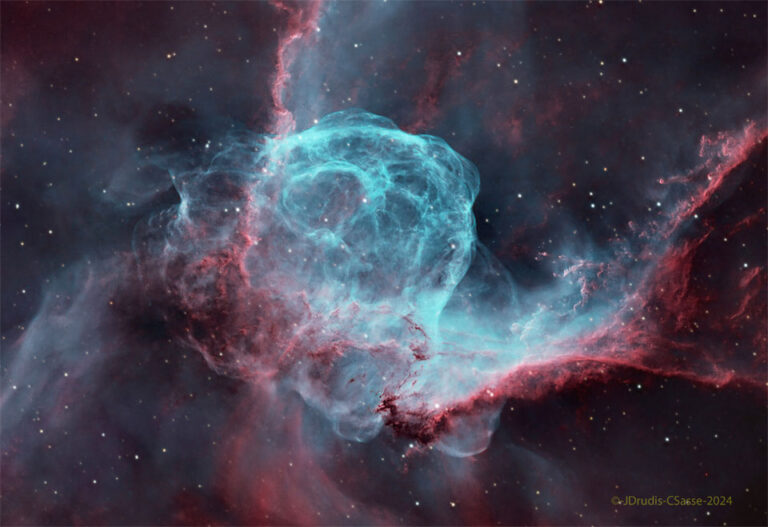
The Nebulous Realm of WR 134
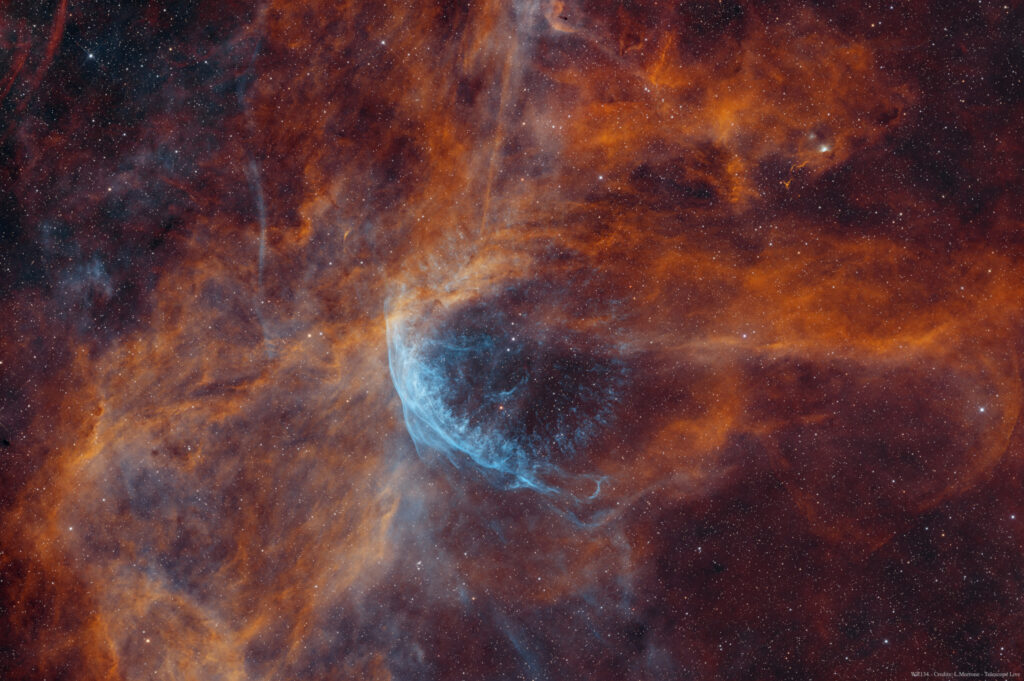
Image Credit & Copyright: Luigi Morrone and Telescope Live
Explanation: This cosmic snapshot covers a field of view over twice as wide as the full Moon within the boundaries of the high-flying constellation Cygnus. Made using astronomical narrowband filters, the image highlights the bright edge of a ring-like nebula traced by the glow of ionized hydrogen and oxygen gas. Embedded in the region’s expanse of interstellar clouds, the complex, glowing arcs are sections of shells of material swept up by the wind from Wolf-Rayet star WR 134, the brightest star near image center. Distance estimates put WR 134 about 6,000 light-years away, making this telescopic frame over 100 light-years across. Shedding their outer envelopes in powerful stellar winds, massive Wolf-Rayet stars have burned through their nuclear fuel at a prodigious rate and end their final phase of massive star evolution in a spectacular supernova. Their stellar winds and final supernova explosion enrich the interstellar material with heavy elements to be incorporated in future generations of stars.
A Collision of Galaxy Clusters
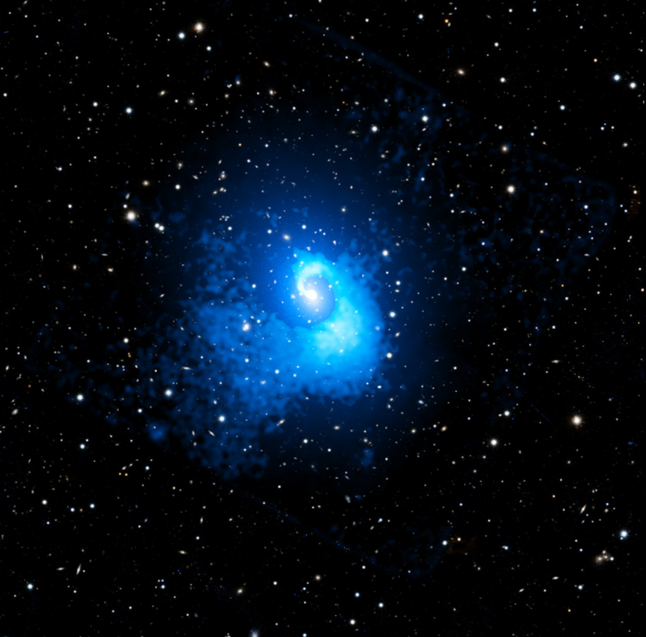
Image Credit: X-ray: NASA/CXC/CfA/C. Watson et al.; Optical: PanSTARRS; Image Processing: NASA/CXC/SAO/N. Wolk and P. Edmonds
Text: Cecilia Chirenti (NASA GSFC, UMCP, CRESST II)
Explanation: This big beautiful spiral shines in X-ray light. It is about 20 times larger than our Galaxy. It belongs to Abell 2029, a galaxy cluster one billion light-years away. (To see only the galaxies, hover your cursor over the image, or follow this link.) Galaxy clusters are the largest structures in the universe that are supported by gravity. Abell 2029 is formed by thousands of galaxies, surrounded by a huge cloud of hot gas and the equivalent of hundreds of trillions times the mass of the Sun in dark matter. The spiral is made of gas, mostly hydrogen and helium, heated to tens of millions of degrees. It was found in a recent study that used data from NASA’s Chandra X-ray Observatory to show that Abell 2029 had a collision with a smaller cluster four billion years ago. The collision affected the gravitational field and caused the intracluster gas to slosh, like wine moving in a wine glass, shaping the spiral.
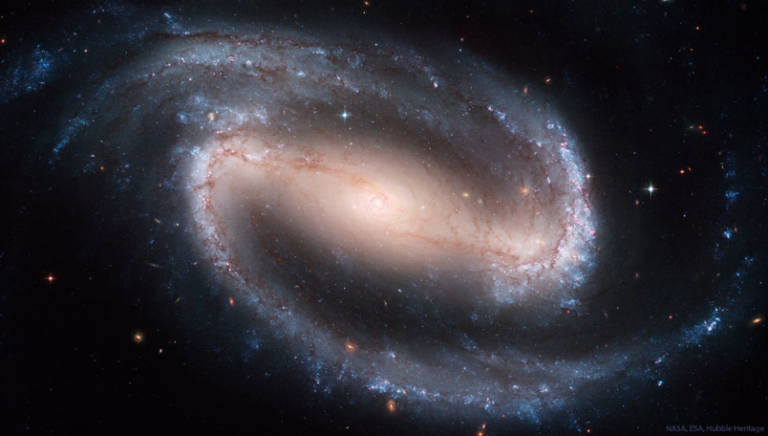
NGC 1300: Barred Spiral Galaxy
Image Credit: NASA ESA, Hubble Heritage
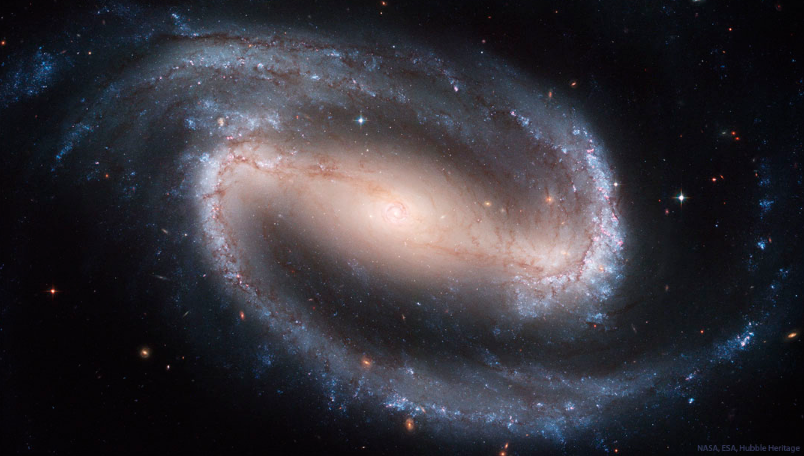
Explanation: Across the center of this spiral galaxy is a bar. And at the center of this bar is smaller spiral. And at the center of that spiral is a supermassive black hole. This all happens in the big, beautiful, barred spiral galaxy cataloged as NGC 1300, a galaxy that lies some 70 million light-years away toward the constellation of the river Eridanus. This Hubble Space Telescope composite view of the gorgeous island universe is one of the most detailed Hubble images ever made of a complete galaxy. NGC 1300 spans over 100,000 light-years and the Hubble image reveals striking details of the galaxy’s dominant central bar and majestic spiral arms. How the giant bar formed, how it remains, and how it affects star formation remains an active topic of research.
Aurora Slathers Up the Sky
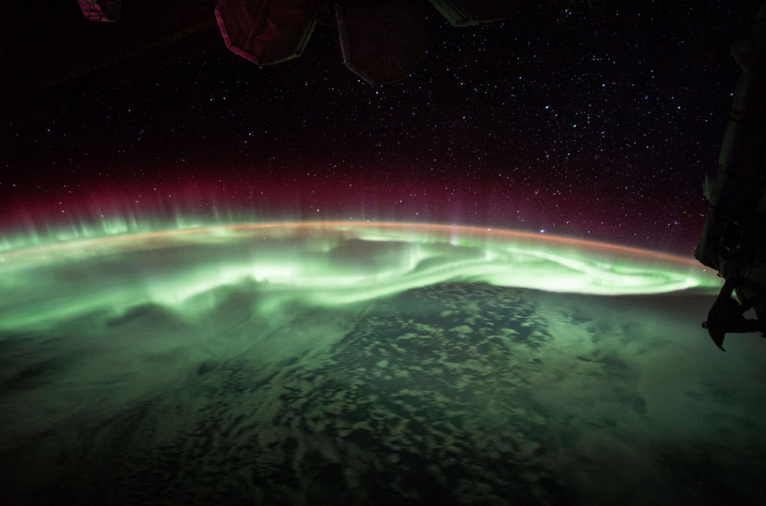
Image Credit: Jack Fischer, Expedition 52, NASA
Explanation: Like salsa verde on your favorite burrito, a green aurora slathers up the sky in this 2017 June 25 snapshot from the International Space Station. About 400 kilometers (250 miles) above Earth, the orbiting station is itself within the upper realm of the auroral displays. Aurorae have the signature colors of excited molecules and atoms at the low densities found at extreme altitudes. Emission from atomic oxygen dominates this view. The tantalizing glow is green at lower altitudes, but rarer reddish bands extend above the space station’s horizon. The orbital scene was captured while passing over a point south and east of Australia, with stars above the horizon at the right belonging to the constellation Canis Major, Orion’s big dog. Sirius, alpha star of Canis Major, is the brightest star near the Earth’s limb.
Trifid Pillars and Jets
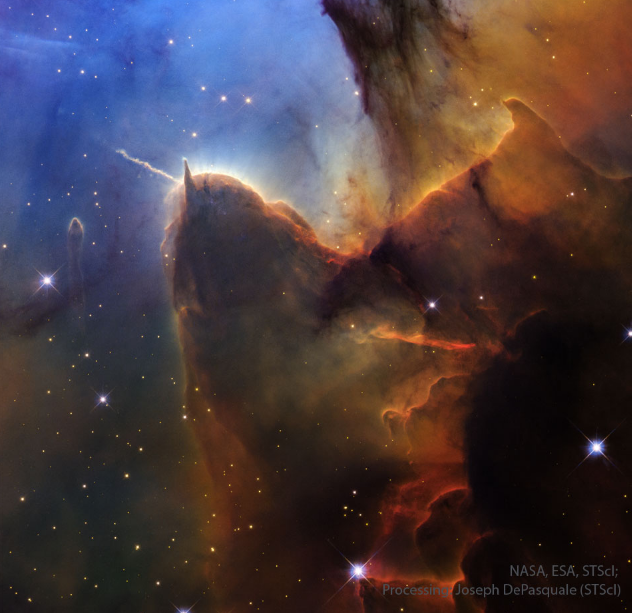
Image Credit: NASA, ESA, STScI; Processing: J. DePasquale (STScI)
Explanation: Dust pillars are like interstellar mountains. They survive because they are more dense than their surroundings, but they are slowly being eroded away by a hostile environment. Visible in the featured picture by the Hubble Space Telescope is the end of a huge gas and dust pillar in the Trifid Nebula (M20), punctuated by a smaller pillar pointing up and an unusual jet pointing to the upper left. Many of the bright dots are newly formed stars. A star near the small pillar’s end is slowly being stripped of its accreting gas by radiation from a tremendously brighter star situated off the top of the image. The jet extends nearly a light-year and would not be visible without external illumination. As gas and dust evaporate from the pillars, the hidden stellar source of this jet will likely be uncovered, possibly over the next 20,000 years.
Mystic Mountain Monster being Destroyed
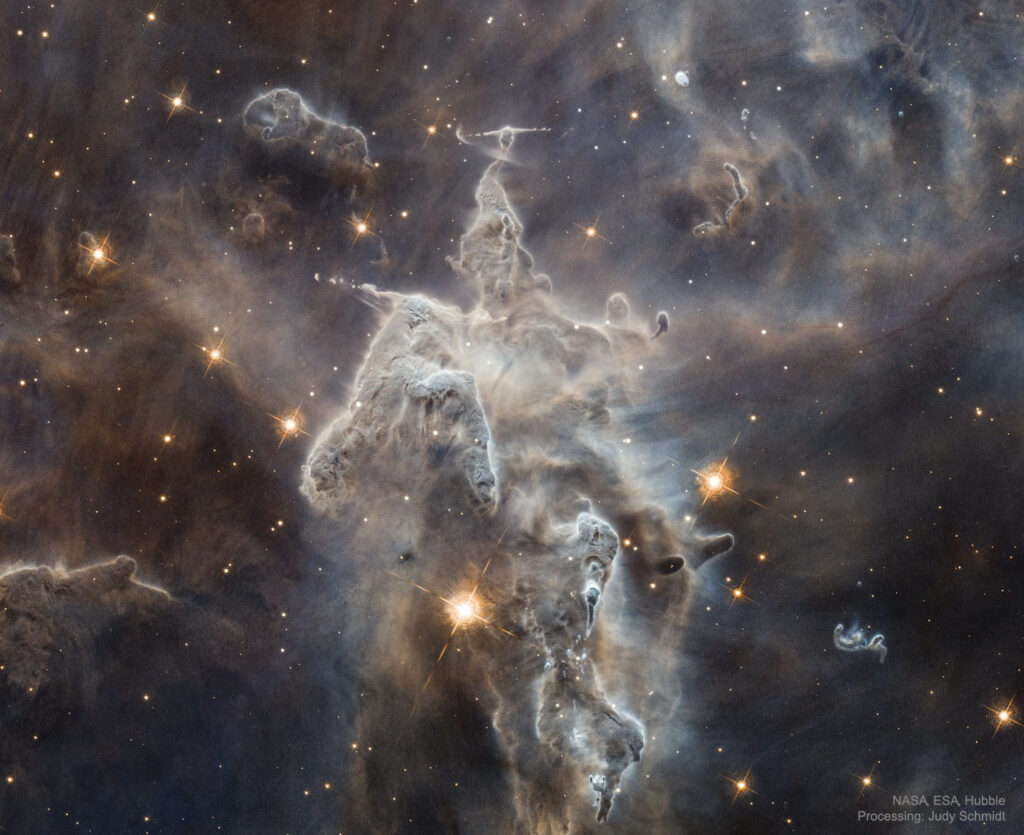
Image Credit: Hubble, NASA, ESA; Processing & License: Judy Schmidt
Explanation: Inside the head of this interstellar monster is a star that is slowly destroying it. The huge monster, actually an inanimate series of pillars of gas and dust, measures light years in length. The in-head star is not itself visible through the opaque interstellar dust but is bursting out partly by ejecting opposing beams of energetic particles called Herbig-Haro jets. Located about 7,500 light years away in the Carina Nebula and known informally as Mystic Mountain, the appearance of these pillars is dominated by dark dust even though they are composed mostly of clear hydrogen gas. The featured image was taken with the Hubble Space Telescope. All over these pillars, the energetic light and winds from massive newly formed stars are evaporating and dispersing the dusty stellar nurseries in which they formed. Within a few million years, the head of this giant, as well as most of its body, will have been completely evaporated by internal and surrounding stars.