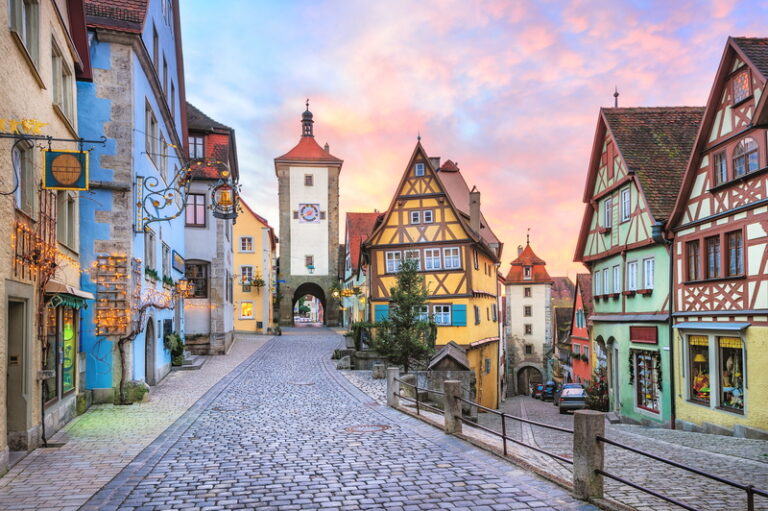
The Eiffel Tower in Paris. The Clock Tower of London. The Busy Streets of Madrid. They are the poster children of the travel industry. However, you spend majority of the time weaving through a dense sea of other humans who came for the same thing. At the same time, there are towns travel blogs do not tell you to go because they are not popular. For travel enthusiasts who love serenity, that is the whole point.
The magic of these towns happen on cobblestone streets that were not designed for crowds, in town squares where the afternoon light lands differently, in places that have been quietly beautiful for centuries without needing anyone to notice.
The towns below are that kind of place. They span three countries and one American coastline. What they share is a depth of character that no major city, however grand, can quite replicate.
Rothenburg ob der Tauber, Germany
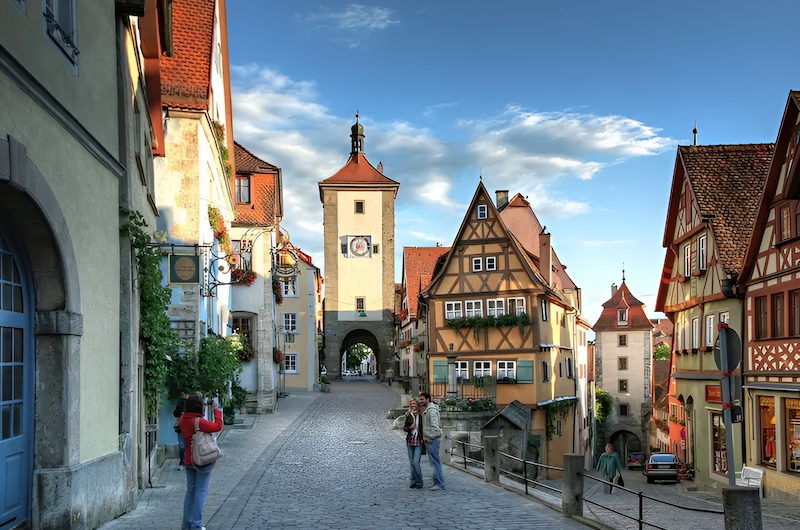
Sitting above the Tauber River valley in the German state of Bavaria, Rothenburg ob der Tauber is one of the best-preserved medieval towns in Europe and one of the very few to have survived the destruction of the Second World War largely intact. Its ring of fortified walls, built between the 13th and 17th centuries, still circles the old town in full. The watchtowers are still standing and visitors can walk between the ramparts.
The town’s origins stretch back to the 10th century, when it served as the seat of the Counts of Comburg-Rothenburg. At its peak in the 14th century, it was a free imperial city of considerable commercial importance. That wealth shows in the architecture: the Market Square, the Town Hall with its Gothic and Renaissance facades, and the maze of narrow lanes lined with half-timbered houses that have barely changed in 400 years.
Weggis and Lake Lucerne, Switzerland
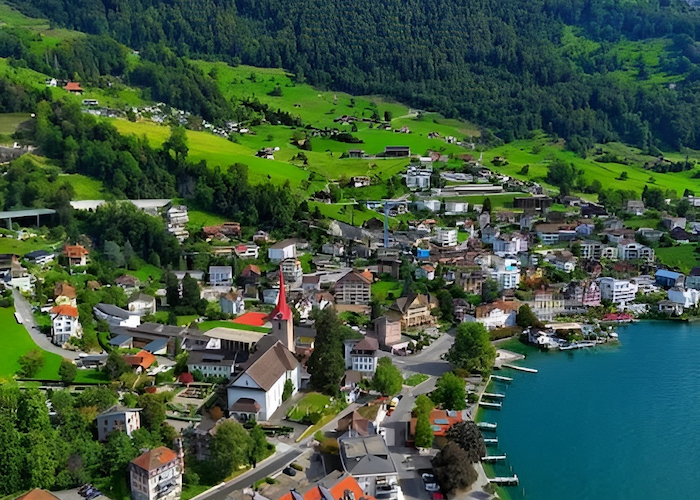
Weggis sits on the southern shore of Lake Lucerne in the canton of Lucerne, sheltered from the north wind by Mount Rigi and facing one of the most arresting views in Switzerland: the lake stretching west toward the city of Lucerne, framed by the peaks of the Alps on every side. The climate here is notably mild for central Switzerland, mild enough that palm trees and fig trees grow in the gardens along the waterfront, an anomaly that has made the town a favored resort since the 19th century.
Leo Tolstoy spent time in Weggis in 1857, and Richard Wagner lived for a period nearby. The town’s parish church, with its Gothic tower reflected in the lake, appears in countless images of the region. The broader Lucerne area, which includes the medieval covered Chapel Bridge in the city center and the remarkable Lion Monument carved into a sandstone cliff in 1820, offers enough history and scenery to anchor a week’s travel without difficulty.
The Rigi is accessible by the world’s first mountain railway opened in 1871, and rises above the town to 1,797 meters and offers a panorama that stretches, on clear days, across much of central Switzerland and into the Austrian Alps.
Lloret de Mar, Spain
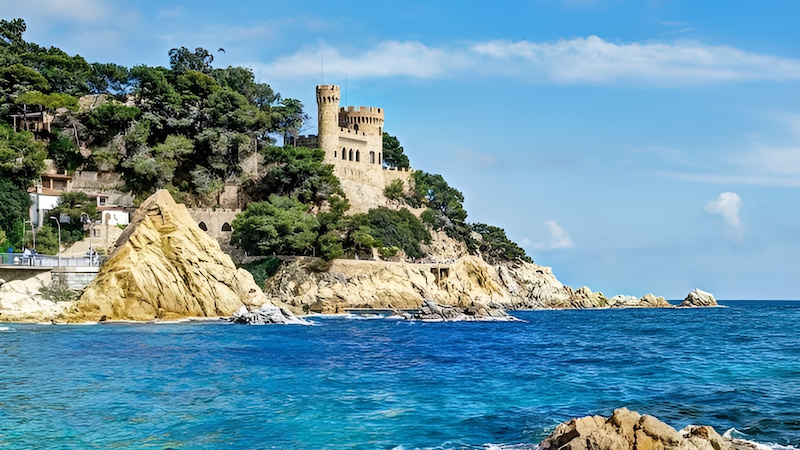
Lloret de Mar is located on the Costa Brava, the rugged stretch of Catalan coastline north of Barcelona, where pine forests and rocky coves meet the Mediterranean Sea. The town’s name, which translates roughly as “laurel of the sea,” hints at a character that tends to get lost in its modern reputation as one of Spain’s busier summer resorts. Behind the beaches and the busy nightlife strip, the old town preserves a different version of the place.
The Church of Sant Roma which is the dominant feature of the original settlement, was largely rebuilt in the early 20th century in a Catalan modernist style, its facade clad in vibrant mosaic tiles depicting religious scenes, saints, and decorative motifs that owe more to Barcelona’s Eixample district than to any traditional Romanesque model. The contrast between the mosaic color and the pale stone of the surrounding streets makes it one of the more visually striking church facades on the Spanish coast.
Burano, Italy
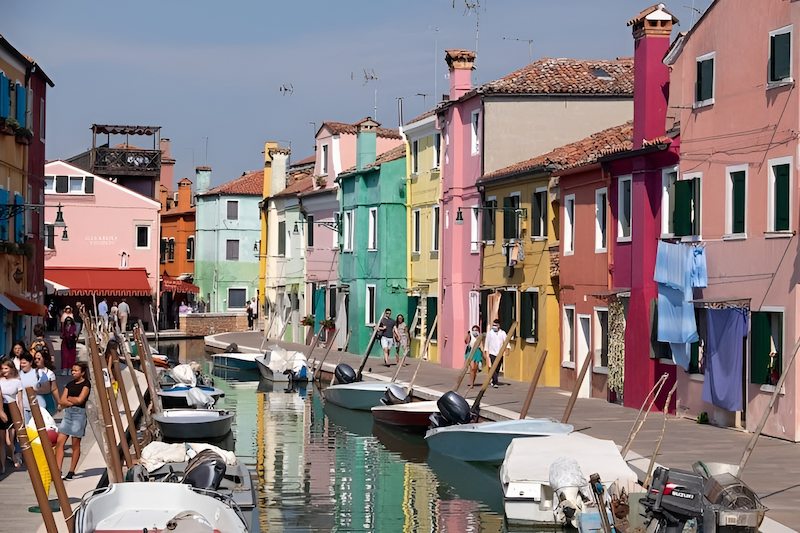
Burano lies in the Venetian Lagoon, about an hour’s ferry ride from Venice, and it is technically an archipelago of small islands connected by bridges, much like Venice itself. What distinguishes it, and has made it one of the most photographed places in Italy, is the color. The houses along Burano’s canals are painted in a spectrum of saturated pinks, yellows, reds, greens, and blues, each facade a different hue from its neighbor, the whole producing an effect that is less picturesque village and more deliberate, accumulated art.
The origin of the tradition is disputed. One account holds that fishermen painted their houses in distinctive colors to find their way home through the lagoon fog. Another pegs the colors to the identity of each fishing family’s boat. The practice is now formally regulated. Residents must apply to the local government for permission to repaint, and the approved colors for each building are listed in an official registry.
Burano has a second tradition of equal age and considerably more delicacy. Lacemaking on the island dates to the 16th century, when women began producing needle lace of exceptional intricacy, a craft that became so associated with Burano that the distinctive Venetian stitch style was named after it. The craft nearly died out in the 19th century before a school was established to revive it, and handmade Burano lace remains among the most technically demanding textile work produced anywhere in Europe.
Oberhofen Castle, Lake Thun, Switzerland
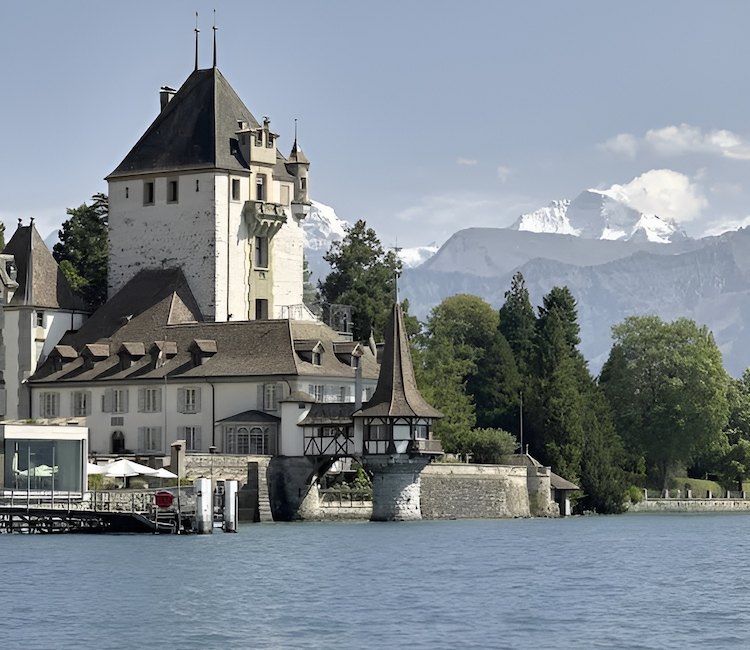
The village of Oberhofen sits on the northern shore of Lake Thun in the Bernese Oberland, a region of the Swiss Alps that contains some of the most dramatic alpine scenery on the continent. The lake, fed by glacial meltwater from the Bernese Alps, is a deep and luminous blue. The Eiger, Monch, and Jungfrau stand in full view to the south.
The castle at the water’s edge has stood in some form since the 12th century. Its original round tower, which still forms the core of the structure, was built as a fortification. Over the following centuries the castle was expanded by successive owners into a more elaborate residence, accumulating architectural layers that range from Romanesque to Gothic to Renaissance to neo-Gothic, the last of these added during a 19th-century restoration that gave the castle much of its current fairytale silhouette. It is now a museum managed by the Bernese Historical Museum and contains period interiors spanning several centuries.
Camden, Maine, USA
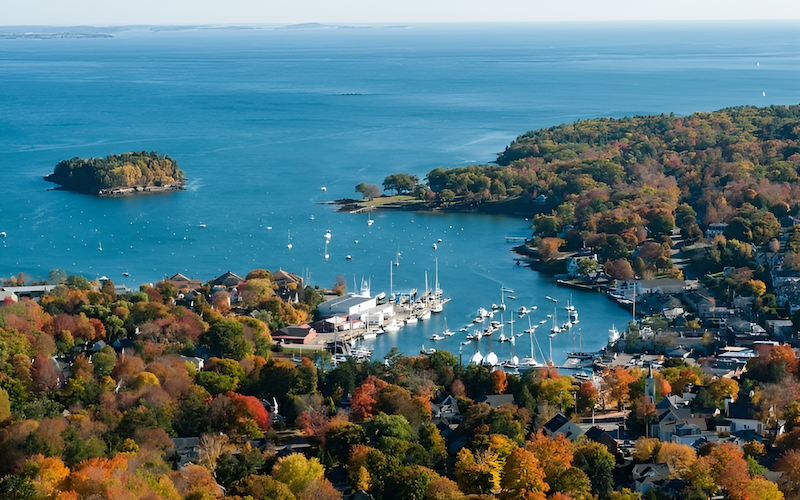
Camden is one of those American coastal towns that appears to have been arranged for the specific purpose of making people reconsider their plans to leave. It sits on Penobscot Bay in Midcoast Maine, at the point where the Camden Hills, a small range of granite peaks, descend directly to the Atlantic shore. It is the only town on the eastern seaboard where you can climb a mountain and look out over the ocean, a fact its residents mention with the quiet pride of people who know they live somewhere genuinely unusual.
The town was incorporated in 1791, and its Victorian architecture along Main Street and Bay View Street reflects the prosperity of a 19th-century mill and shipbuilding economy. The harbor, one of the most photographed on the Maine coast, is home to a fleet of historic windjammers, wooden sailing vessels that take passengers on multi-day cruises along the coast each summer. The Camden Opera House, built in 1894, still hosts regular performances.
The surrounding area offers hiking, kayaking along the island-dotted bay, and the particular variety of quiet that Maine seems to produce in outsized quantities relative to the rest of the American northeast. The peak summer months are July and August, when the days are long and the water, while cold, is swimmable. Fall, when the maple forests on the Camden Hills turn, is the other season worth planning around.
Some of the world’s most rewarding travel happens at a smaller scale than most itineraries allow for. These six towns are evidence of that. Each has its own reasons for existing, its own centuries of accumulated character, and its own special flavour that serves as an argument for why it is worth the detour.