From distant worlds at the edge of the Solar System to colossal nebulae where stars are born and die, the universe continues to reveal scenes that seem almost beyond imagination. These extraordinary images capture cosmic wonders spanning thousands—even millions—of light-years, offering a glimpse into places few people ever stop to consider.
In this collection, you’ll encounter mysterious moons, glowing stellar nurseries, ancient planetary alignments, and the breathtaking remnants of stars that exploded long ago. Each image tells a story of creation, transformation, and the immense forces that shape the cosmos.
Scroll through the gallery and discover some of the most stunning astronomical photographs ever captured. The deeper you look, the more the universe reveals its beauty, mystery, and scale.
Charon: Moon of Pluto
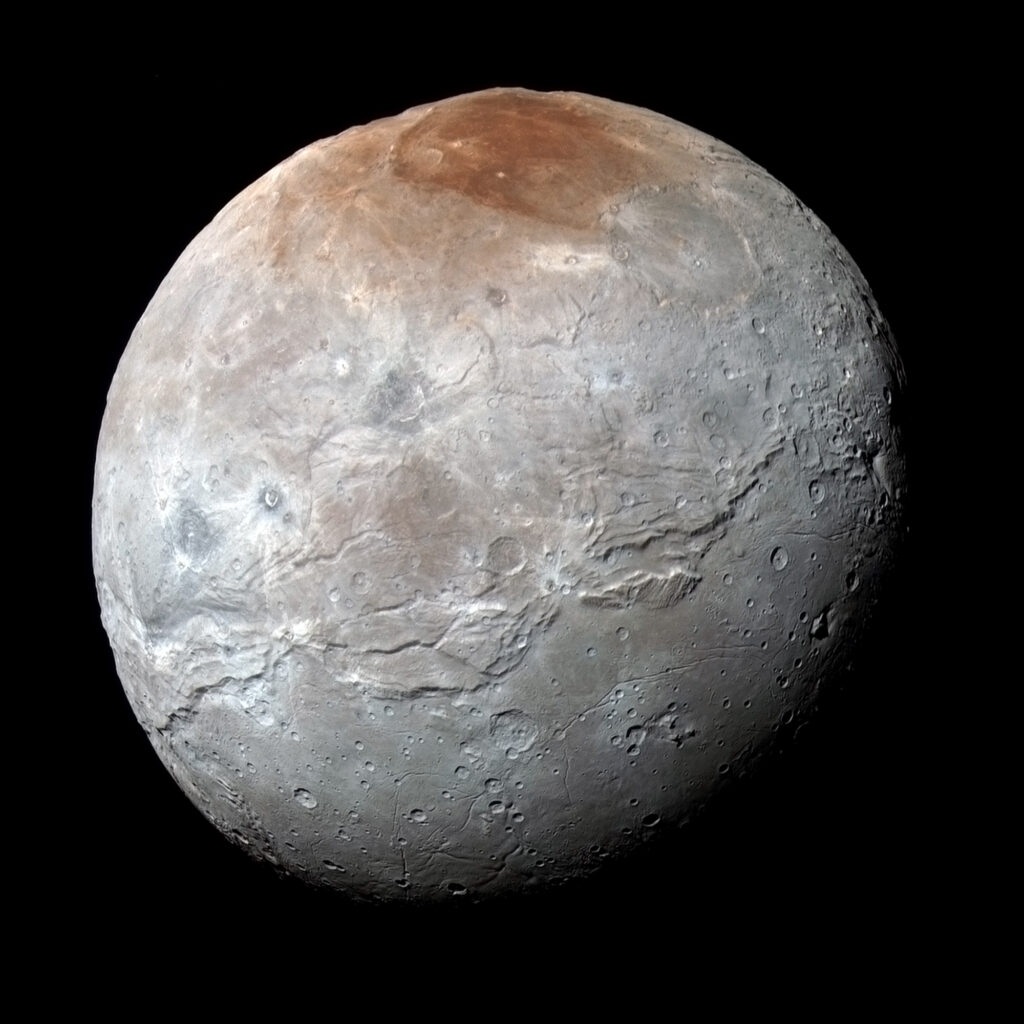
Explanation: A darkened and mysterious north polar region known to some as Mordor Macula caps this premier view of Charon, Pluto’s largest moon. The high-resolution image was captured by the interplanetary space probe New Horizons near its closest approach to distant Pluto on July 14, 2015. The combined blue, red, and infrared image data was processed to enhance colors and follow variations in Charon’s surface properties with a resolution of about 2.9 kilometers (1.8 miles). A stunning image of Charon’s Pluto-facing hemisphere, it also features a clear view of an apparently moon-girdling belt of fractures and canyons that seems to separate smooth southern plains from varied northern terrain. Charon is 1,214 kilometers (754 miles) across. That’s about 1/10th the size of planet Earth but a whopping 1/2 the diameter of Pluto itself, and makes it the largest satellite relative to its parent body in the Solar System. Still, the moon appears as a small bump at about the 1 o’clock position on Pluto’s disk in the grainy, negative, telescopic picture inset at upper left. That image was used by James Christy and Robert Harrington at the U.S. Naval Observatory in Flagstaff to discover Charon in June of 1978.
Jupiter and Venus from Earth
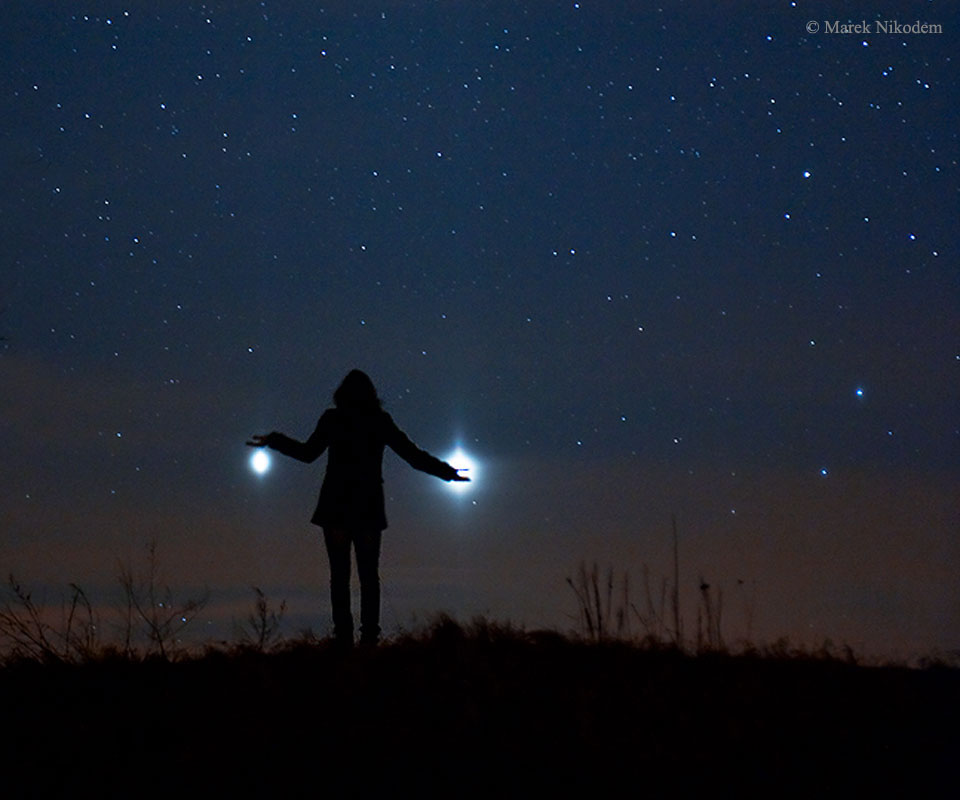
Marek Nikodem (PPSAE)
Explanation: It was visible around the world. The sunset conjunction of Jupiter (left) and Venus (right) in 2012 was visible almost no matter where you lived on Earth. Anyone on our planet with a clear western horizon at sunset could see them. That year, a creative photographer traveled away from the town lights of Szubin, Poland to photograph a near closest approach of the two planets. The bright planets were then separated by only three degrees and his daughter struck a humorous pose. A faint red sunset still glowed in the background. Jupiter and Venus are together again this week after sunset, passing within a degree of each other about two days from today.
Comet R3 PanSTARRS Through Time
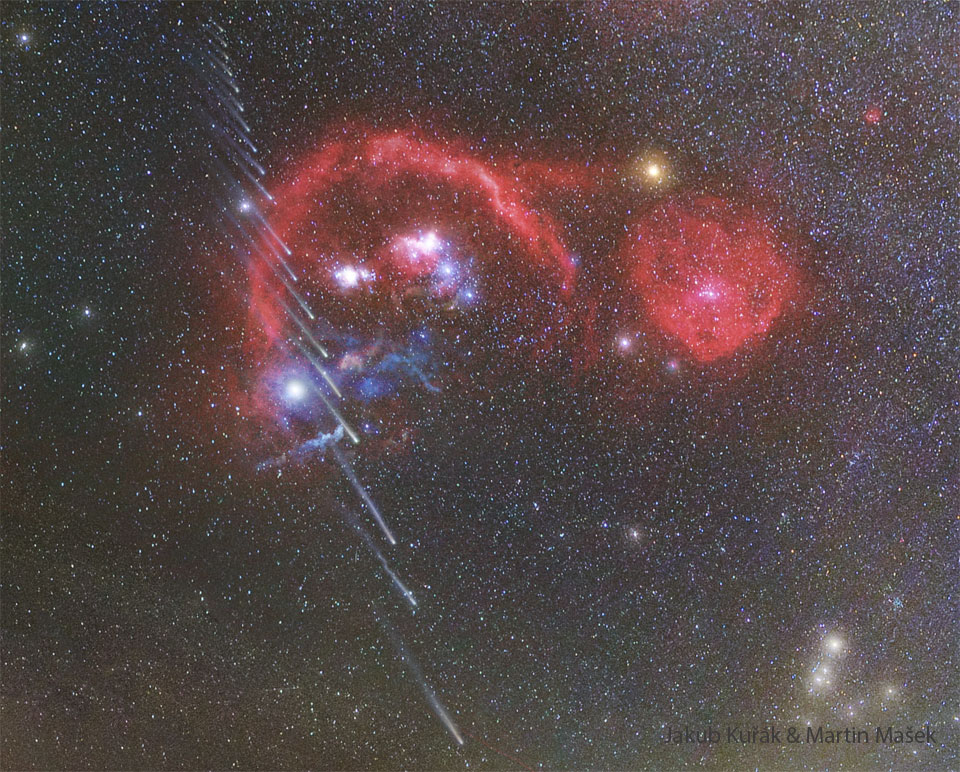
Explanation: What happens to a comet as it leaves our inner Solar System? Now, the arrival of a comet into the inner Solar System is typically heralded with great fanfare and high hopes that the comet will become bright and photogenic. But on the way out, the comet’s nucleus is less warmed by the Sun, less gas and dust are expelled, the bright coma around the nucleus shrinks and fades, and the tail length drops off. Many comets will then return to the outer Solar System and only return in hundreds or thousands of years. In contrast, some comets — like Comet C/2025 R3 (PanSTARRS) — receive a gravitational kick from the planets and so will never return. Pictured, Comet R3 PanSTARRs was imaged deeply many nights in early to mid-May near Cerro Paranal in Chile. Later images appear closer to the top and clearly show the shrinking ion tail.
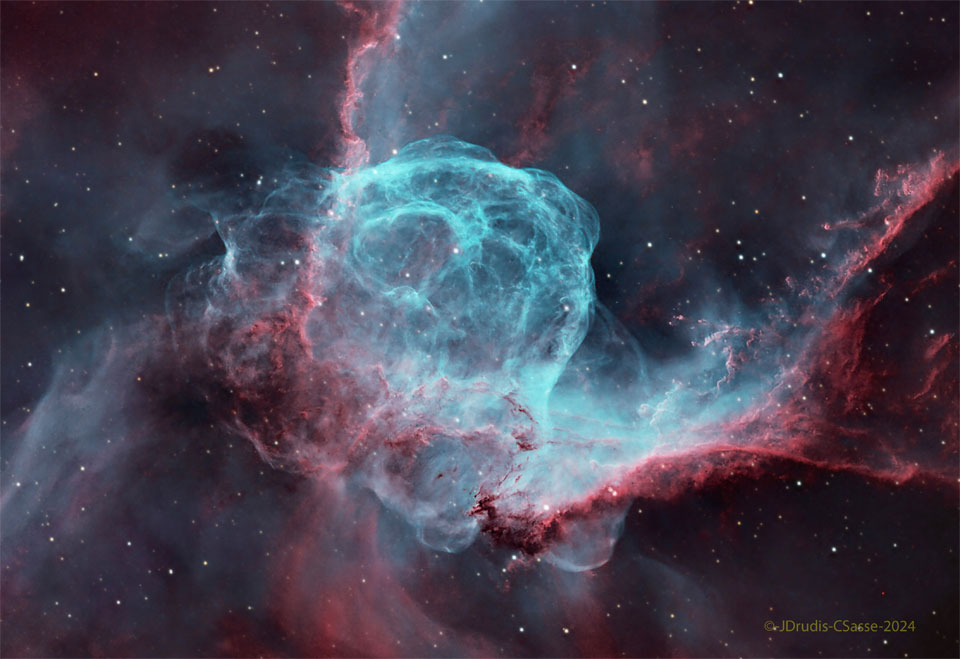
Thor’s Helmet
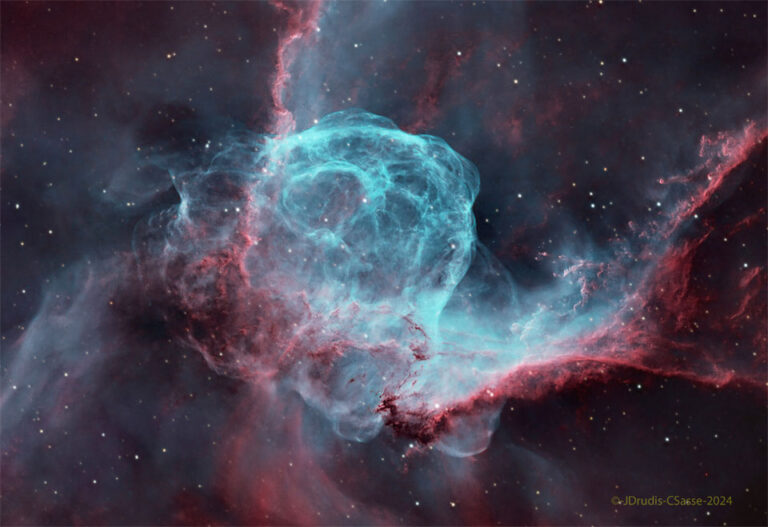
Explanation: Thor not only has his own day (Thursday), but a helmet in the heavens. Popularly called Thor’s Helmet, NGC 2359 is a hat-shaped cosmic cloud with wing-like appendages. Heroically sized even for a Norse god, Thor’s Helmet is about 30 light-years across. In fact, the cosmic head-covering is more like an interstellar bubble, blown by a fast wind from the bright, massive star near the bubble’s center. Known as a Wolf-Rayet star, the central star is an extremely hot giant thought to be in a brief, pre-supernova stage of evolution. NGC 2359 is located about 15,000 light-years away toward the constellation of the Great Overdog. This sharp image is a combination of deep images taken in light emitted by hydrogen (red) and oxygen (blue). The star in the center of Thor’s Helmet is expected to explode in a spectacular supernova sometime within the next few thousand years.
The Eagle Nebula and Friends
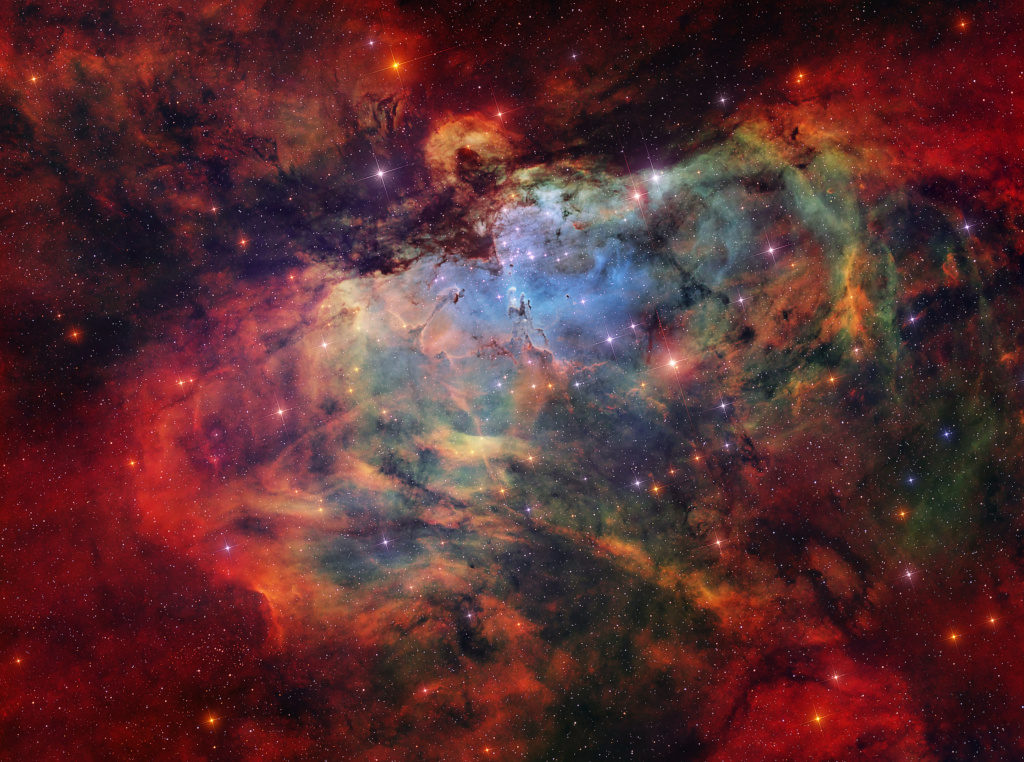
Explanation: What looks as if it is going to swallow the great Pillars of Creation? The Eagle Nebula (M16) is not a bird, a plane, or Superman. M16 is actually a combination of several celestial objects. NGC 6611 is the young star cluster that appears to peak out beneath the Eagle’s “wings”. The ultraviolet light from these stars ionizes the surrounding gas, creating the emission nebula IC 4703. The Stellar Spire is seen reaching towards the Pillars of Creation from the left. Both are structures of cold gas and dust that are optimal for star formation. Some astronomers previously thought the Pillars of Creation had been evaporated away by a supernova. Because M16 is 6,000 light years away, we would not be able to see the Pillars’ destruction for thousands more years. However, there is no conclusive evidence of the theorized supernova, so the Pillars of Creation will likely continue to create stars for millions of years.
The Mermaid Nebula Supernova Remnant
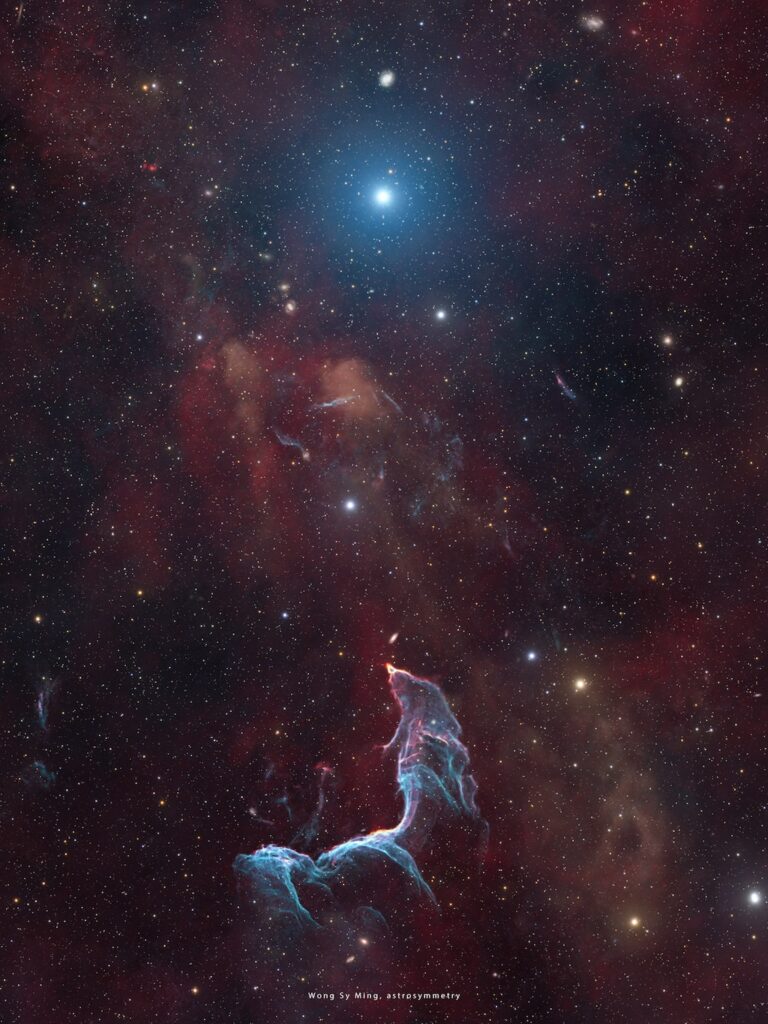
| NASA Sy Ming Wong; Processing: Guangyan Gao
Explanation: Could the Little Mermaid turn into stardust instead of seafoam? It would seem so in this beautiful nebula. The featured image shows the Mermaid Nebula, also known as the Betta Fish Nebula, which is part of the G296.5+10.0 Supernova Remnant. The blue color visible here originates from doubly ionized oxygen (OIII), while the deep red is emitted by hydrogen gas. Estimated to be located a few thousand light-years away and about 10,000 years old, this nebula was formed when a massive star exploded as a supernova. It left behind a peculiar pulsar, a young radio-quiet neutron star that spins around about twice every second. The bright stars shown in the image are unassociated with the nebula. The pulsar can be detected in the X-rays but it does not have a confirmed detection in the optical (visible light) so far. As a result, the pulsar itself is not visible in this image.
Venus and Jupiter: Conjunction from Avebury
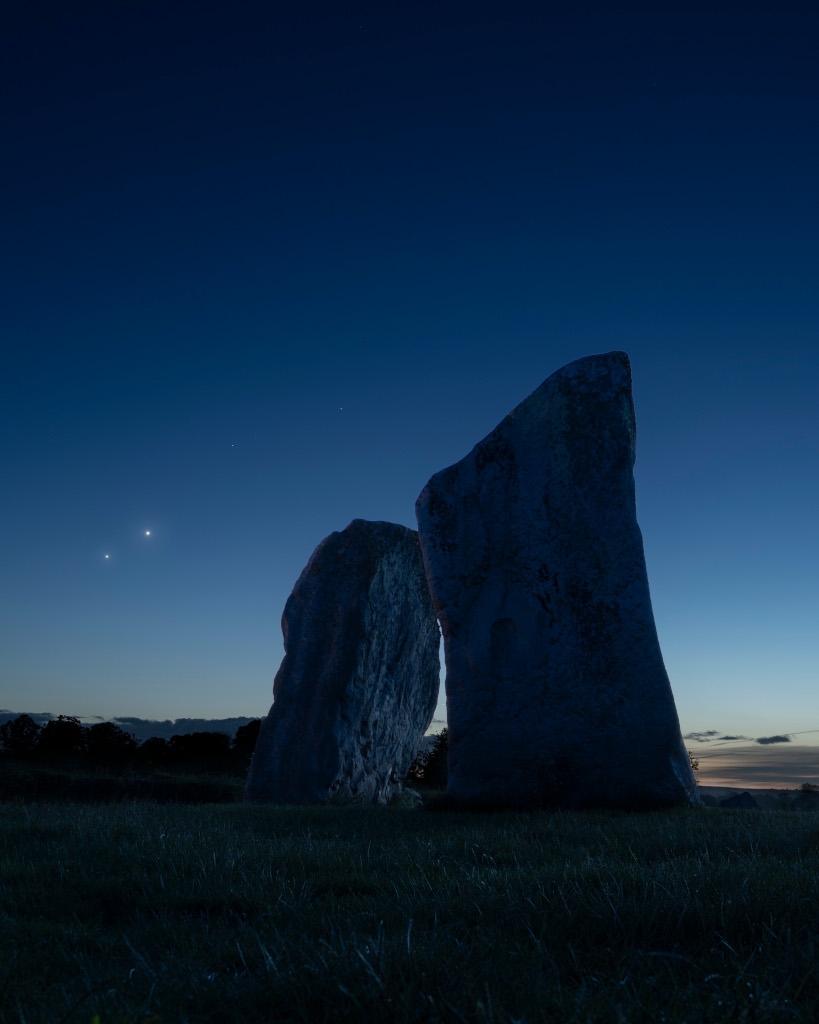
Explanation: To see Venus and Jupiter together this month, you won’t need binoculars or even a telescope. Just look up after sunset and you’ll find them emerging as the sky grows dark near the western horizon. In fact, on June 9 the two brightest planets were in close conjunction, separated on the sky by less than 2 degrees from our perspective. Since (brighter) inner planet Venus orbits the Sun faster than outer planet Jupiter, it catches up with and passes the outer planet along the ecliptic roughly every 13 months. But every three years or so their resulting conjunction can be viewed far enough from the Sun to be easily seen in Earth’s twilight skies. On June 9, the two celestial beacon’s close “cosmic kiss” was captured here next to two large standing stones, the remains of a cove near the center of a 4,000 year old stone circle at Avebury, UK. Larger than Stonehenge, the Avebury henge and stone circle complex is also recognized as one of the most significant neolithic ceremonial sites on planet Earth.
Source: NASA.GOV