The California Gold Rush was the most significant event in the history of the settlement of the western frontier. The initial discovery was made in January 1848, but news traveled slowly and although many miners arrived in 1848, the beginning of the Gold Rush was the following year in 1849.
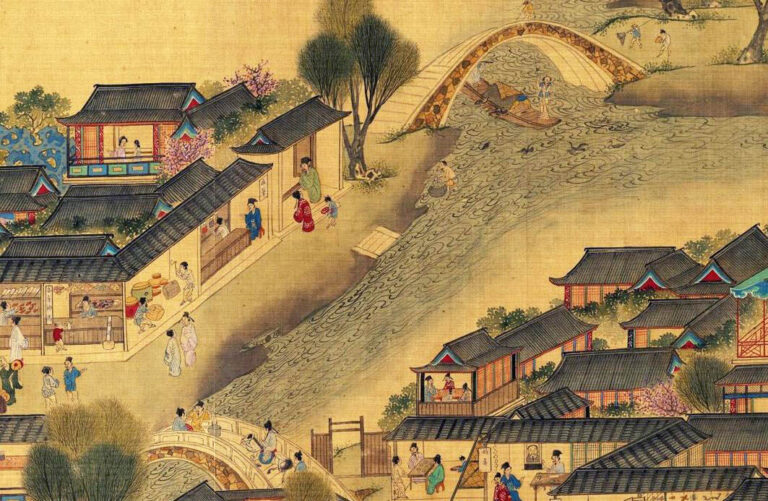
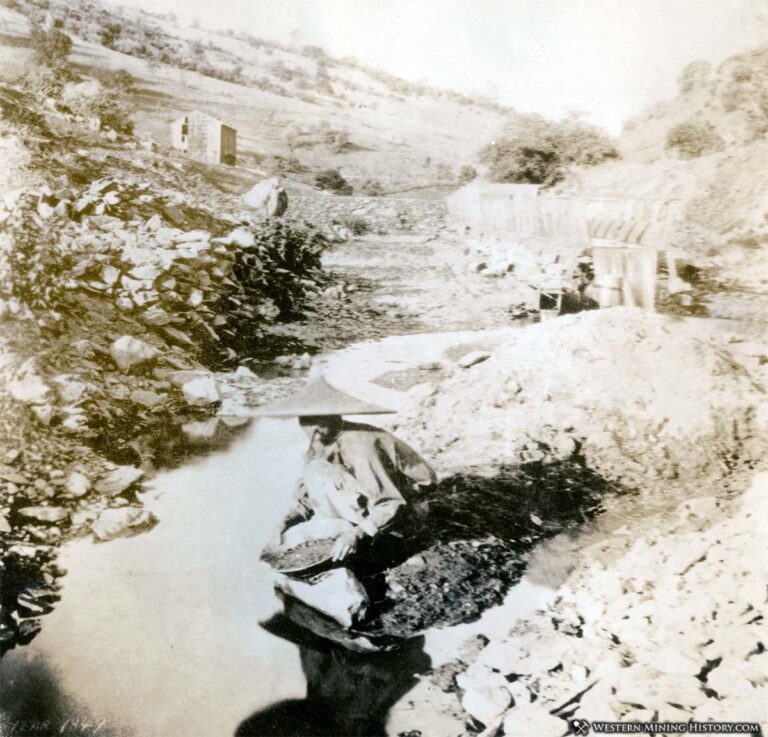
In 1848 news of the discovery reached the East Coast by ship, south all the way around the tip of South America, a journey that could take six months or more. The news traveled down the coast to Mexico and South America, and over the Pacific Ocean to China, much faster than it reached America’s population centers. South Americans and Chinese were the first to arrive in 1848, at a time when California’s non-native population was primarily Mexican.
When news of the gold discovery arrived in the East, people were initially skeptical. California might as well have been the other side of the world at that time, and few were willing to risk everything to chase rumors. However, that all changed on December 5, 1848, as US President James K. Polk confirmed the discovery of gold in an address to Congress. Men by the thousands began preparations for the trek to California, and by the Spring of 1849, the great Gold Rush was on.
The rush to the California gold fields transformed both California and the nation. Between 1849 and 1855, and estimated 300,000 people from around the globe arrived in California. The population grew so quickly that in September 1850, California became a state without going through the usual territorial status.
“the discovery which electrified the world, altered the course of western history, greatly accelerated the development of California, and had national and international ramifications”

Discovery of Gold at Sutter’s Mill
James Marshall was not the first to find gold in California, nevertheless it was this New Jersey carpenter, in the employ of John Sutter, who made the effective discovery which electrified the world, altered the course of western history, greatly accelerated the development of California, and had national and international ramifications.
For years, John Sutter, grantee and almost feudal baron of a large Mexican grant in the vicinity of present day Sacramento, desired to provide a supply of lumber for his own use and for sale. Consequently he provided for the establishment of two mills, a sawmill at Coloma and a gristmill at Natoma. The latter mill was to use the products of the former in its construction.
In August 1847, Sutter signed a contract with Marshall which provided that Marshall should erect and operate the mill and that Sutter should supply the labor, tools, supplies and equipment. After they had determined the location for the proposed mill on the South Fork of the American River, in a small valley which was later to be called Coloma, they built two cabins, one to house the workers and the other the boss—Marshall.
The work of construction of the mill advanced quite rapidly after its commencement in September. Laborers, Indians, Mormons and others were employed and the work on the mill was almost finished by January of the following year (1848). This early completion was due in considerable measure to the industry and abilities of the Mormon workers who had been recently discharged from the Mormon Battalion.

The story of this group of soldiers and their part in the discovery of gold in California is of considerable interest. The battalion, about 500 strong, volunteered for service in the United States Army for the Mexican War. Besides desiring to aid their country, the Saints enlisted in order to become the advance guard of the Mormon westward migration. The termination of their one year enlistments found a considerable portion of the original group in Southern California, after having opened a wagon road to the West.

Some of the group, about 81 in number, re-enlisted for an additional year of service. The remainder, some 240, were released after exemplary service. By this time the Battalion had been informed that the new headquarters for the faith was to be in Utah, and they began to head for that destination.
The soldiers were not, however, the only Mormons in the Golden State at the time, for on July 31, 1846, a group of homeseekers had arrived aboard the sailing ship Brooklyn led by Sam Brannan as presiding elder. Late in 1847, this same Brannan met the homeward bound group of ex-soldiers at Tahoe Basin. There he urged the men to remain in California until the following spring since it was already September.
Brannan’s entreaties were of no avail but a bundle of letters and an epistle from Brigham Young, which arrived the following day, changed the minds of many. In the epistle they were advised by their leader to remain in California until they had outfitted themselves, unless their presence in Utah was essential. Thereupon most of the group turned back and sought employment in California.
About 40 of the young ex-soldiers found work with John Sutter, some being sent to Natoma, some to Coloma, and others remaining to work at Sutter’s Fort at New Helvetia. Probably about nine of the Mormons were assigned to Marshall at Coloma, this group entering into a contract with Sutter whereby they agreed to remain in his employ until the completion of work on the sawmill.

One of the Mormons, Henry Bigler, kept a diary from which historians have drawn heavily in determining the details of the discovery and the actual date thereof as January 24, 1848. In spite of the discovery of gold the Mormons completed the provisions of their contract with Sutter and engaged in mining only when they were off duty at the mill.
By March 11th, the work on the sawmill was finished and it was in operation. Presently the Mormons terminated their contract with Sutter, were paid off at about $1.50 per day for work at the mill, and set about digging gold on a full time basis at Mormon Island near the confluence of the South and Main Forks of the American River.
Here many of the Saints joined in the enterprise, working the area until June of the same year, at which time the members of the Battalion decided to leave for the home in Utah which they had not yet seen. In July, forty-five of them united and left the easy money of California for the alkaline plains of Salt Lake Valley, because of their attachment to the faith. This marked the first return of miners from the gold fields, and was a preview of the role that California would play in the filling in of the West.
Just as the date of the discovery has been a subject of discussion, the accounts of the events leading up to Marshall’s find and his actions thereafter conflict in different narratives. The main facts however are in accord.

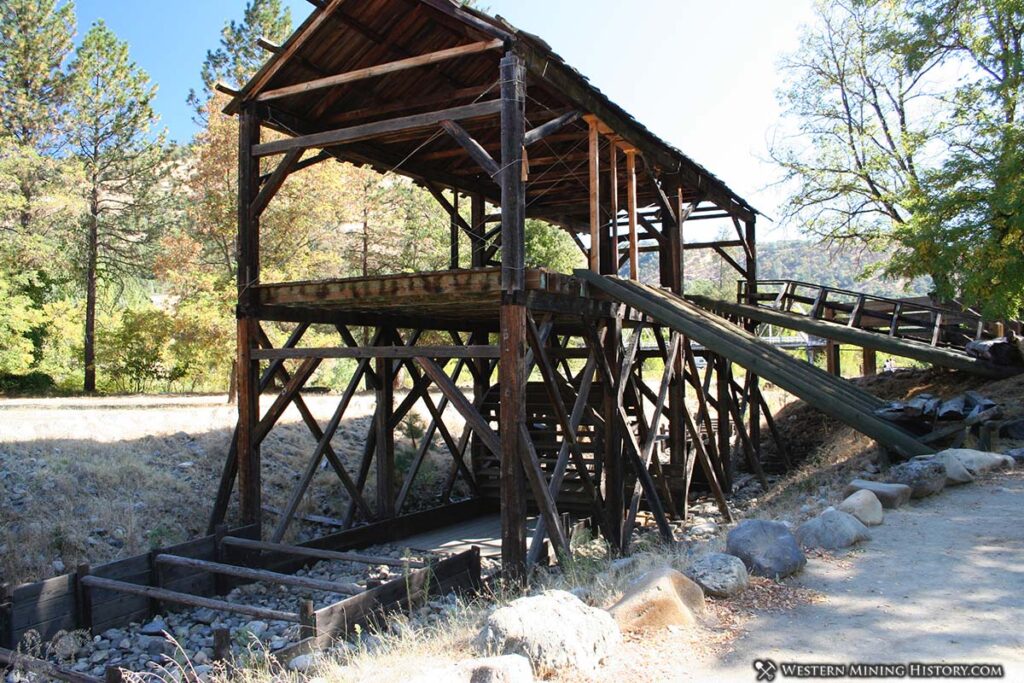
The sawmill constructed by Marshall was operated by diverting the water of the river through a headrace into the forebay of the mill, whence it was directed to the waterwheel, flowed under the length of the mill and escaped back into the river through a tailrace. It was determined by test in December 1847, that the mill foundations had been set too low and therefore the water did not escape sufficiently into the tailrace. This necessitated the deepening and widening of the race to expedite the run-off of the water.
Leaving the mill in the same month, Marshall ordered that this work should be accomplished in his absence. Upon his return to the mill, Marshall found that his orders had been carried out, but the race was still not sufficiently deep. Additional excavation was done during the daytime, and at night the gates of the forebay were opened and the running water assisted the work by clearing away the loose dirt. Boulders were blasted out and the decomposed granite was being dug out manually by both the Indian laborers and the Mormons.

On the morning of January 24th, when Marshall was making one of his frequent inspections of the tailrace, something glittering caught his eye. There, resting in a shallow depth of water, was a yellow flake of what appeared to be metal. Testing its malleability, he became hopeful; he picked up some more flakes, placed them in the crown of his hat and made his way to where the men were working.
The Mormons shared Marshall’s interest and several elementary tests were made, by which the group could not disprove the possibility that the metal was gold. Work on the mill was halted temporarily while all went to the tailrace to pick up these available flakes of metal.

The plans of Sutter and Marshall to keep the discovery quiet came to naught, for the secret of gold could not be kept. The ex-soldiers at the Coloma millsite confided the secret to their associates at Natoma. Charles Bennett, sent by Sutter to Monterey to secure a grant of the Coloma area from Governor Mason, could not restrain himself from showing the gold in Benicia and San Francisco. Upon hearing of gold, Sam Brannan, the Mormon elder, could not curb his curiosity and visited Sacramento. Upon his return to San Francisco he did not hesitate to proclaim the discovery.
Even Sutter, who most wanted the secret maintained, confided the news to General Vallejo. The first published announcement of the discovery of gold was made on March 15, 1848, in the San Francisco weekly newspaper The Californian, and no longer could the discovery be withheld from the whole world.

Gold Fever at San Francisco
As word got out about the discovery at Sutter’s Mill, there was a frenzied rush among current residents of Pacific settlements to the newly discovered gold fields. A September newspaper article described the situation in San Francisco: “Three-fourths of the houses in San Francisco are actually vacated; even lawyers have closed their books, and taken passage, with a spade and wooden dish, to make fortunes by washing out gold from the sands on the Sacramento.”

“Cooks and stewards have refused fifty dollars a month to remain under their former employers. Clerks’ wages have risen to a thousand a year. Carpenters, blacksmiths, and teamsters, who in April received three dollars a day, now refuse ten; a few still remain, making shovels, spades, and pick-axes, and turning wooden bowls, who are making upwards of twenty dollars a day.”
“I am informed that one blacksmith makes ten to fifteen small picks, and sells them as a favor at $6 each. English spades and shovels will command $10 each, and by taking them to the gold regions, yield a heavy profit by selling again. There is not in town one new shovel for sale, perhaps not a tin cup or pan. A boat requires four days to go from here to Sutter’s Fort. The fare has risen from $4 to $12, each passenger carrying his own provisions. Wooden bowls, worth in New York 10 to 15 cents, would sell here now for $5.”
The article goes on to explain the situation of a local newspaper that was forced to cease publication due to the fact that there were few open businesses to pay for advertising, and few citizens left to read the newspaper as nearly everyone had left for the placer mines.

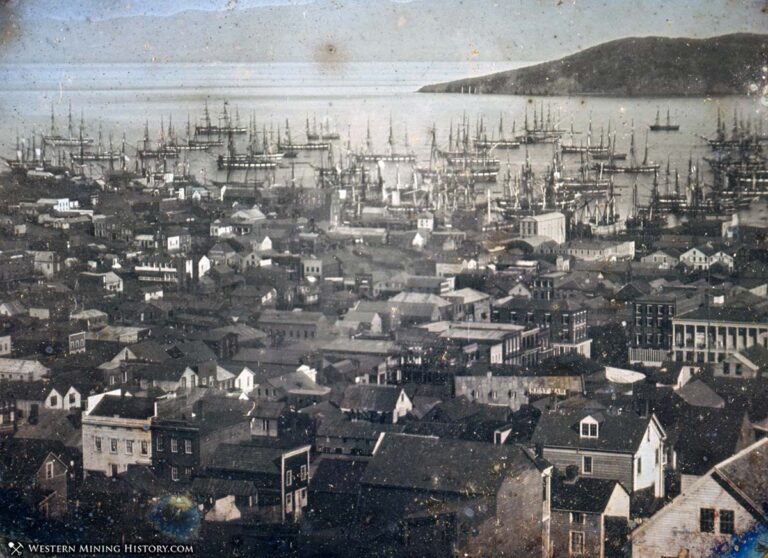
Ships were arriving at San Francisco in large numbers and many of the crews were abandoning them to set out for the gold fields. Even if captains had a crew, there was not enough cargo or passengers leaving to justify the cost of the return trip.
These ships choked the harbor, and many of them were sunk or burned to make room for new arrivals. Others were deliberately ran aground so owners could assert “salvage rights” and claim valuable real estate. These ships were then used as storage, or sometimes even commercial buildings like hotels or saloons.

The legacy of the abandoned Gold Rush ships is an ongoing part of San Francisco’s history as the ships are sometimes unearthed as part of new construction projects. It is estimated that around 40 ships are buried beneath the Embarcadero and the Financial District, which was once the original shoreline.
San Francisco was an empty shell by the fall of 1848, but in 1849 when the global rush to California began, it became the most important port city on the Pacific coast. In 1847 an estimated 400 people lived in the settlement, the next year that number was 25,000, and by 1852 a staggering 150,000 people inhabited the city.

As a result of the Gold Rush, San Francisco went from a small village to one of the nation’s most important cities in less than a decade.
To be continued…
Source: Western Mining History