NASA’s Nancy Grace Roman Space Telescope will be a discovery machine, thanks to its wide field of view and resulting torrent of data. Scheduled to launch no later than May 2027, with the team working toward launch as early as fall 2026, its near-infrared Wide Field Instrument will capture an area 200 times larger than the Hubble Space Telescope’s infrared camera, and with the same image sharpness and sensitivity. Roman will devote about 75% of its science observing time over its five-year primary mission to conducting three core community surveys that were defined collaboratively by the scientific community. One of those surveys will scour the skies for things that pop, flash, and otherwise change, like exploding stars and colliding neutron stars.
Called the High-Latitude Time-Domain Survey, this program will peer outside of the plane of our Milky Way galaxy (i.e., high galactic latitudes) to study objects that change over time. The survey’s main goal is to detect tens of thousands of a particular type of exploding star known as type Ia supernovae. These supernovae can be used to study how the universe has expanded over time.
“Roman is designed to find tens of thousands of type Ia supernovae out to greater distances than ever before,” said Masao Sako of the University of Pennsylvania, who served as co-chair of the committee that defined the High-Latitude Time-Domain Survey. “Using them, we can measure the expansion history of the universe, which depends on the amount of dark matter and dark energy. Ultimately, we hope to understand more about the nature of dark energy.”
Probing Dark Energy
Type Ia supernovae are useful as cosmological probes because astronomers know their intrinsic luminosity, or how bright they inherently are, at their peak. By comparing this with their observed brightness, scientists can determine how far away they are. Roman will also be able to measure how quickly they appear to be moving away from us. By tracking how fast they’re receding at different distances, scientists will trace cosmic expansion over time.
Only Roman will be able to find the faintest and most distant supernovae that illuminate early cosmic epochs. It will complement ground-based telescopes like the Vera C. Rubin Observatory in Chile, which are limited by absorption from Earth’s atmosphere, among other effects. Rubin’s greatest strength will be in finding supernovae that happened within the past 5 billion years. Roman will expand that collection to much earlier times in the universe’s history, about 3 billion years after the big bang, or as much as 11 billion years in the past. This would more than double the measured timeline of the universe’s expansion history.
Recently, the Dark Energy Survey found hints that dark energy may be weakening over time, rather than being a constant force of expansion. Roman’s investigations will be critical for testing this possibility.
Seeking Exotic Phenomena
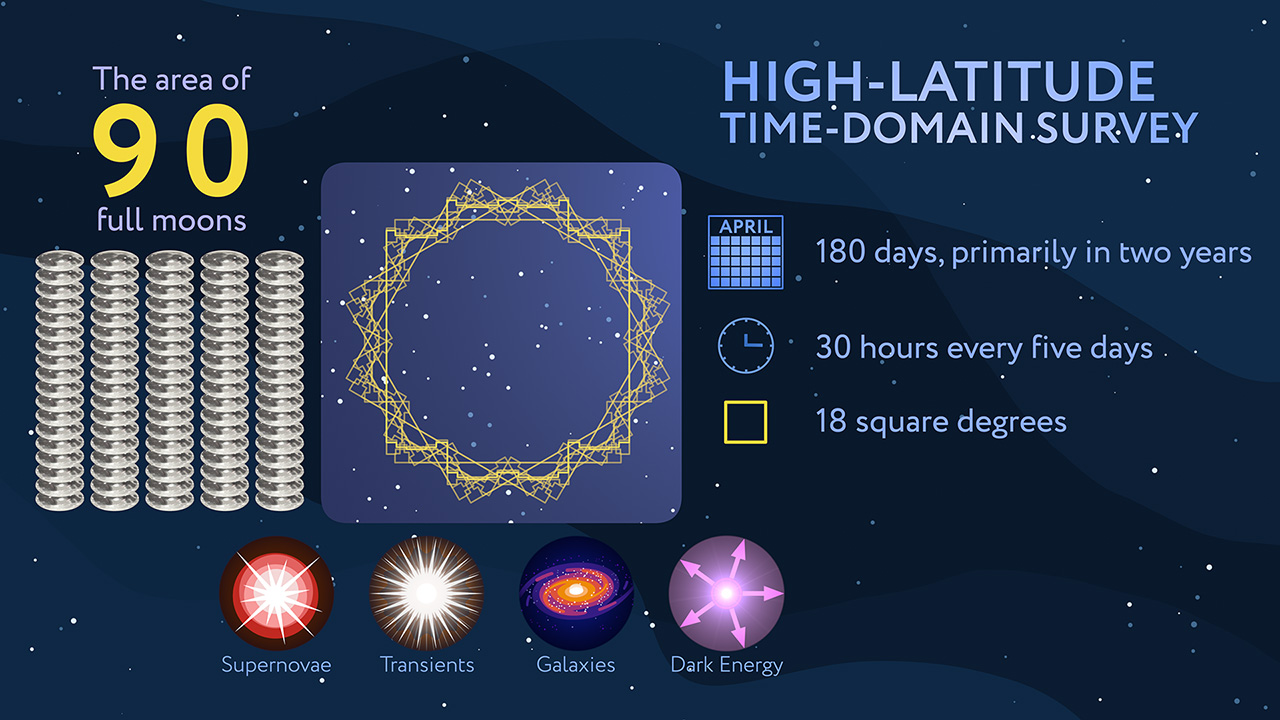
To detect transient objects, whose brightness changes over time, Roman must revisit the same fields at regular intervals. The High-Latitude Time-Domain Survey will devote a total of 180 days of observing time to these observations spread over a five-year period. Most will occur over a span of two years in the middle of the mission, revisiting the same fields once every five days, with an additional 15 days of observations early in the mission to establish a baseline.
“To find things that change, we use a technique called image subtraction,” Sako said. “You take an image, and you subtract out an image of the same piece of sky that was taken much earlier — as early as possible in the mission. So you remove everything that’s static, and you’re left with things that are new.”
The survey will also include an extended component that will revisit some of the observing fields approximately every 120 days to look for objects that change over long timescales. This will help to detect the most distant transients that existed as long ago as one billion years after the big bang. Those objects vary more slowly due to time dilation caused by the universe’s expansion.
“You really benefit from taking observations over the entire five-year duration of the mission,” said Brad Cenko of NASA’s Goddard Space Flight Center in Greenbelt, Maryland, the other co-chair of the survey committee. “It allows you to capture these very rare, very distant events that are really hard to get at any other way but that tell us a lot about the conditions in the early universe.”
This extended component will collect data on some of the most energetic and longest-lasting transients, such as tidal disruption events — when a supermassive black hole shreds a star — or predicted but as-yet unseen events known as pair-instability supernovae, where a massive star explodes without leaving behind a neutron star or black hole.
Survey Details
The High-Latitude Time-Domain Survey will be split into two imaging “tiers” — a wide tier that covers more area and a deep tier that will focus on a smaller area for a longer time to detect fainter objects. The wide tier, totaling a bit more than 18 square degrees, will target objects within the past 7 billion years, or half the universe’s history. The deep tier, covering an area of 6.5 square degrees, will reach fainter objects that existed as much as 10 billion years ago. The observations will take place in two areas, one in the northern sky and one in the southern sky. There will also be a spectroscopic component to this survey, which will be limited to the southern sky.
“We have a partnership with the ground-based Subaru Observatory, which will do spectroscopic follow-up of the northern sky, while Roman will do spectroscopy in the southern sky. With spectroscopy, we can confidently tell what type of supernovae we’re seeing,” said Cenko.
Together with Roman’s other two core community surveys, the High-Latitude Wide-Area Survey and the Galactic Bulge Time-Domain Survey, the High-Latitude Time-Domain Survey will help map the universe with a clarity and to a depth never achieved before.
The Nancy Grace Roman Space Telescope is managed at NASA’s Goddard Space Flight Center in Greenbelt, Maryland, with participation by NASA’s Jet Propulsion Laboratory in Southern California; Caltech/IPAC in Pasadena, California; the Space Telescope Science Institute in Baltimore; and a science team comprising scientists from various research institutions. The primary industrial partners are BAE Systems, Inc. in Boulder, Colorado; L3Harris Technologies in Melbourne, Florida; and Teledyne Scientific & Imaging in Thousand Oaks, California.