Giovanni di Ser Giovanni Guidi, known as Lo Scheggia, was the younger brother of Masaccio. ‘Born in 1406 in San Giovanni Valdarno, Giovanni was the son of a notary, whose name he took, and of Monna Jacopa. He was also the younger brother of Masaccio (1401-1428), a much more famous painter one of the great innovators of Florentine Renaissance art, along with Brunelleschi and Donatello. His grandfather Mone, who was a cassaio, that is a craftsman specialised in the construction of chests, had a decisive influence on Giovanni’s training and set him on the path to his artistic career, where he was to specialise prevalently in the decoration of domestic furnishings, such as wedding chests, birth trays, spalliera panels, strongboxes and headrests. Giovanni was nicknamed lo Scheggia (the splinter), on account of his slender build, but also probably because of the particular specialisation of his work, constantly in contact with wooden artefacts.
After a period as a mercenary, he settled in Florence and between 1420-1421 entered the workshop ofBicci di Lorenzo, an artist still bound to outmoded, traditional stylistic features and insensitive both to the new perspective approaches and also to the more modern sophistication of the international Gothic. Consequently Giovanni moved on to the workshop of his brother Masaccio, with whom he lived in Via de’ Servi with their mother. In effect, Giovanni’s early activity is characterised by the marked influence of Masaccio, which led Giovanni to translate the forms into geometric terms (as in the small ancon with the Madonna and Child and Two Angels in the Museo Horne in Florence).

In 1432 he registered in the Guild of Stonemasons and Carpenters and the following year in that of the Physicians and Apothecaries, which was the Guild the artists enrolled in, a sign that he was by this stage specialised in his profession as a decorator of interiors and domestic furnishings, collaborating with carpenters and inlayers. His work was considerably appreciated in the city, so much so that he received commissions even for Palazzo Medici, including a spalliera panel (lost) illustrating the joust of 1469, which was set above strongboxes and chests in the first-floor chamber of Lorenzo il Magnifico (Cavazzini 1999, p. 13). As a painter of sacred subjects, in altarpieces and large-scale wall paintings, lo Scheggia’s commissioners were instead largely located in the rural district, in particular the Valdarno.
Between 1436 and 1440 he collaborated on the intarsia cupboardsforthe Sagrestia delle Messe in the Duomo. In the interim, after the death of his brother (1428), Giovanni turned his attention to those artists who had shown themselves to be the most gifted interpreters of Masaccio’s teaching, such as Beato Angelico, Domenico Veneziano and Filippo Lippi.
Around 1449 he created his masterpiece, the birth tray for Lorenzo il Magnifico portraying the Triumph of Fame (New York, Metropolitan Museum).
Dating to 1456-1457 is the only signed work by loScheggia: the fresco portraying the Martyrdom of Saint Sebastian and Scenes from the Life of Saint Anthony Abbot in the oratory of San Lorenzo in San Giovanni Valdarno. It is around this work that the critics have reconstructed the corpus of the painter’s works, drawing partly on catalogues gathered under the conventional names, Master of the Cassone Adimari and Master of Fucecchio.
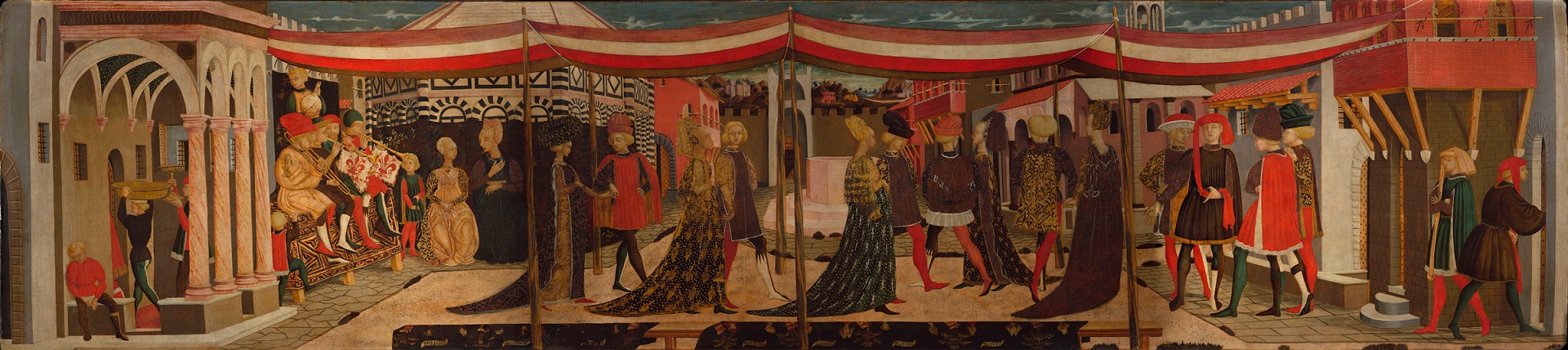
Among the most important works referred to lo Scheggia are the so-called Cassone Adimari, or Adimari Wedding Chest, actually a spalliera panel (Florence, Accademia Gallery), the birth tray showing the Gioco del civettino and the curved panels portraying the Triumphs of Death, of Fame, of Love and of Eternity, now in Palazzo Davanzati (the latter originating from the Medici collections) and the altarpiece of the Madonna and Child with Saints Lazarus, Martha, Mary Magdalene and Sebastian originating from the Collegiate church of Fucecchio (now in the Museo Civico).’
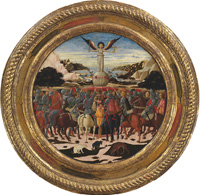
Lo Scheggia was the younger brother of Masaccio, the short-lived revolutionary artist of the early quattrocento in Florence. Scheggia, on the contrary, had a long, successful career and was particularly adept at the production of secular domestic objects.
This salver was commissioned to celebrate the birth of Lorenzo de’ Medici (1449–1492), de facto ruler of Florence from 1469 until his death, and is the largest and most elaborate surviving birth tray. Twenty-eight men on horseback are shown pledging allegiance to Fame, a beautiful winged woman who holds a sword and a statuette of Cupid as she stands atop a globe on an enormous pedestal. This scene, known as the Triumph of Fame and based on Boccaccio’s Amorosa Visione (1342) and Petrarch’s Trionfi (1354–74), clearly shows the dynastic ambitions of Piero de’ Medici, Lorenzo’s father, who commissioned the work and gave it to his wife Lucrezia Tornabuoni. The tray must have had considerable commemorative value to Lorenzo, as it was hanging in his bedchamber at the time of his death.
The back of the salver, once resplendent with silver decoration that has now oxidized, is embellished with Piero de’ Medici’s emblem, a long-standing Medici family symbol of eternity, usually encircling three feathers in reference to the ostrich, associated with the Resurrection. The feathers, red, white, and green represent the three theological virtues of faith, hope, and charity.
At the top are the coats of arms of the Medici and the Tornabuoni. To the left of the central feather are the eight red balls of the Medici, and to the right the rampant lion of the Tornabuoni.'[0]
Reclining Youth
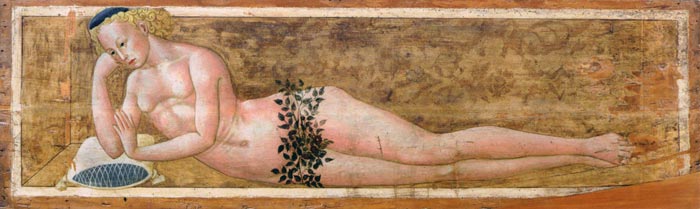
Cassoni (wedding chests) were constructed by specialized carpenters who delivered them to the painters’ workshop to be adorned with scenes on the front and side panels and often on the lids. The inside was often decorated with textile patterns and a male or female nude reclining in the entire length of the lid.
The picture shows the inner lid of a wedding chest with the image of a reclining youth. The female pendant of it is in the Victoria and Albert Museum, London. This images of a private nature promoted fertility, the female nudes are notable predecessors of Titian’s and Giorgione’s naked Venus figures.
Ameto’s Discovery of the Nymphs

The Master of 1416 is the name given to the painter of an altarpiece of the Madonna and Child Enthroned with Saints, dated 1416, in the Galleria dell’Accademia, Florence.
The panels are the recto and verso of a marriage salver. They show episodes from the Commedia delle ninfe fiorentine, an amatory allegory written about 1342 by Giovanni Boccaccio.
The right panel, the obverse, or front, of a marriage salver, illustrates an episode in which the hunter Ameto, dressed in red, peers over a hill and then approaches some nymphs in a thicket, attracted by the singing of Lia. In the background Ameto and the nymphs hunt. The nymphs instruct Ameto in the meaning of love in a later episode of the story. The salver dates about 1410.
Frederick III and Leonora of Portugal in Rome

In 1452, the Holy Roman Emperor, Frederick III, visited Italy to marry Leonora of Portugal and be crowned. At the left, in front of old St. Peter’s in Rome, the pope crowns the kneeling emperor. In the center, the imperial procession makes its way through the city. At the right, Frederick III knights his brother on the Ponte Sant’Angelo. This chest is unusual because it depicts contemporary political events. Smaller panels originally decorated the ends of the cassone (and were in the same positions as installed here). They show the Empress Leonora returning to her palace, and Frederick III riding through Rome after his coronation. On the sides of the pedestal: Leonora and Ladislaus Returning to the Vatican and Frederick III’s Procession through Rome.
‘The Sienese provenance of this cassone may not be accidental, as four spalliera panels by the artist are in the Pinacoteca Nazionale there.
The picture was acquired by 1914 by the great New York collector and philanthropist, Otto Kahn, who owned such masterpieces as Ghirlandaio’s Portrait of Giovanna Tornabuoni and Carpaccio’s Young Knight (both now, Madrid, Thyssen-Bornemisza Museum). It was subsequently purchased by Sir Thomas Merton, presumably in or after 1950, when Dr. Alfred Scharf published his A Catalogue of Pictures and Drawings from the Collection of Sir Thomas Merton, F.R.S. at Stubbins House, Maidenhead, which is the fullest account of the collection.

Source: Art in Tuscany