The Middle Land

Historic Discovery: Hubble Captures Cosmic Catastrophic in the Nearby Planetary System

77 Views

By ESA/Hubble

Add Your Heading Text Here

In a historical milestone, catastrophic collisions in a nearby planetary system were witnessed for the first time by astronomers using the NASA/ESA Hubble Space Telescope. As they observed the bright star Fomalhaut, the scientists saw the impact of massive objects around the star. The Fomalhaut system appears to be in a dynamical upheaval, similar to what our solar system experienced in its first few hundred million years after formation.

This is certainly the first time I’ve ever seen a point of light appear out of nowhere in an exoplanetary system,” said principal investigator Paul Kalas of the University of California, Berkeley. “It’s absent in all of our previous Hubble images, which means that we just witnessed a violent collision between two massive objects and a huge debris cloud unlike anything in our own solar system today. Amazing!”

Just 25 light-years from Earth, Fomalhaut is one of the brightest stars in the night sky. Located in the constellation Piscis Austrinus, also known as the Southern Fish, it is more massive and brighter than the Sun and is encircled by several belts of dusty debris.

In 2008, scientists used Hubble to discover a candidate planet around Fomalhaut, making it the first stellar system with a possible planet found using visible light. That object, called Fomalhaut b, now appears to be a dust cloud masquerading as a planet – the result of colliding planetesimals. While searching for Fomalhaut b in recent Hubble observations, scientists were surprised to find a second point of light at a similar location around the star. They call this object “circumstellar source 2” or “cs2” while the first object is now known as “cs1.”


Tackling mysteries of colliding planetesimals
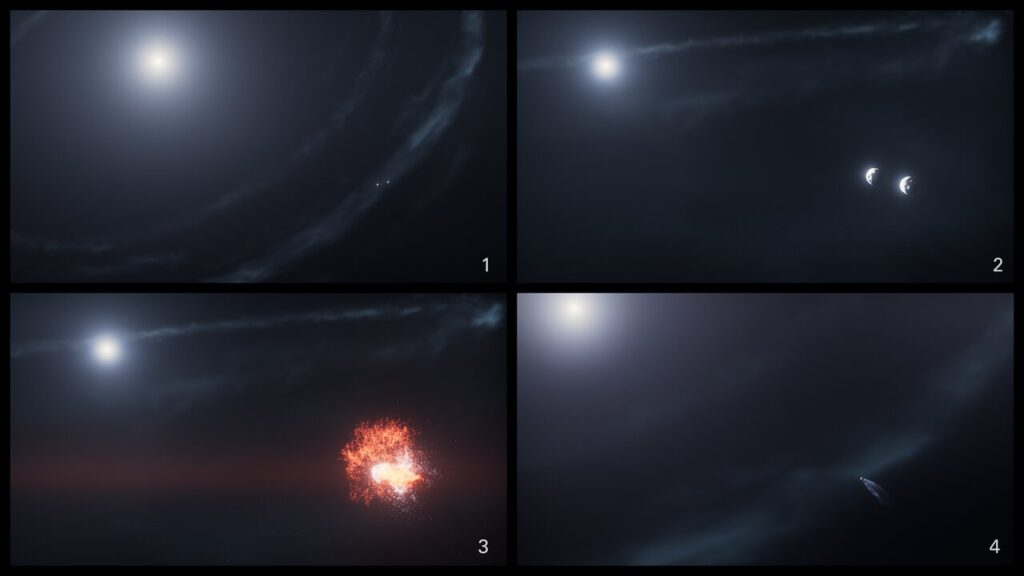
This four-panel image labelled 1 to 4 shows the sequence of events leading up to, during, and following the collision of two objects in orbit around a star. (Photo: NASA, ESA, STScI, R. Crawford (STScI)

Why astronomers are seeing both of these debris clouds so physically close to each other is a mystery. If the collisions between asteroids and planetesimals were random, cs1 and cs2 should appear by chance at unrelated locations. Yet, they are positioned intriguingly near each other along the inner portion of Fomalhaut’s outer debris disk.

Another mystery is why scientists have witnessed these two events within such a short timeframe. “Previous theory suggested that there should be one collision every 100,000 years, or longer. Here, in 20 years, we’ve seen two,” explained Kalas. “If you had a movie of the last 3,000 years, and it was sped up so that every year was a fraction of a second, imagine how many flashes you’d see over that time. Fomalhaut’s planetary system would be sparkling with these collisions.”

Collisions are fundamental to the evolution of planetary systems, but they are rare and difficult to study.

“The exciting aspect of this observation is that it allows researchers to estimate both the size of the colliding bodies and how many of them there are in the disk, information which is almost impossible to get by any other means,” said co-author Mark Wyatt at the University of Cambridge in England. “Our estimates put the planetesimals that were destroyed to create cs1 and cs2 at just 30 kilometres in size, and we infer that there are 300 million such objects orbiting in the Fomalhaut system.”

“The system is a natural laboratory to probe how planetesimals behave when undergoing collisions, which in turn tells us about what they are made of and how they formed,” explained Wyatt.
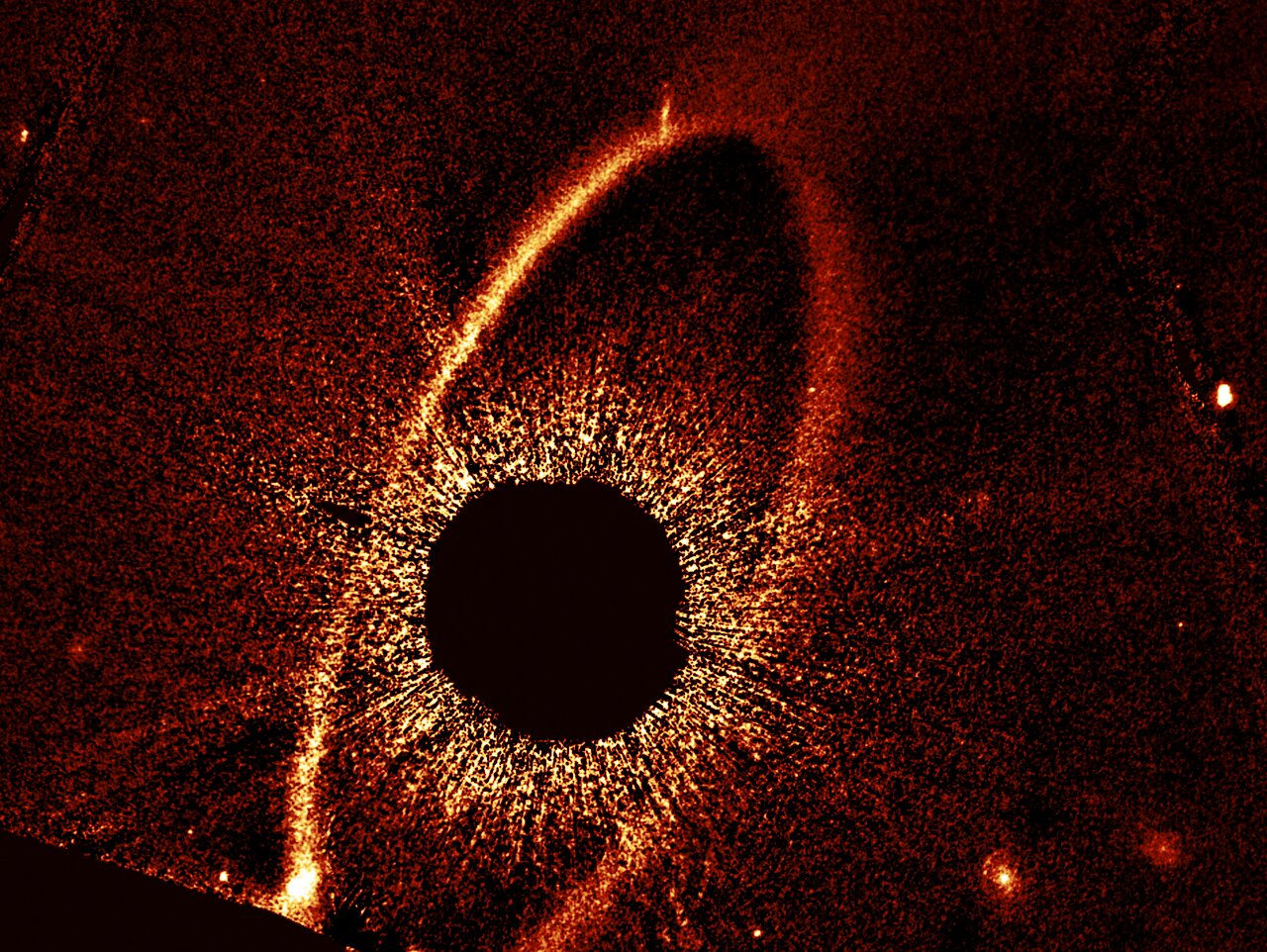
This composite NASA/ESA Hubble Space Telescope image shows the debris ring and dust clouds cs1 and cs2 around the star Fomalhaut. For comparison, dust cloud cs1, imaged in 2012, is pictured with dust cloud cs2, imaged in 2023. The dashed circles mark the location of these clouds. When dust cloud cs2 suddenly appeared, astronomers quickly noticed they had witnessed the violent collision of two massive objects. Previously thought to be a planet, cs1 is now classified as a similar debris cloud. In this image, Fomalhaut itself is masked out to allow the fainter features to be seen. (Photo: NASA, ESA, P. Kalas (UC Berkeley), J. DePasquale (STScI)

Cautionary tale

The transient nature of Fomalhaut cs1 and cs2 poses challenges for future space missions aiming to directly image exoplanets. Such telescopes may mistake dust clouds like cs1 and cs2 for actual planets.

“Fomalhaut cs2 looks exactly like an extrasolar planet reflecting starlight,” said Kalas. “What we learned from studying cs1 is that a large dust cloud can masquerade as a planet for many years. This is a cautionary note for future missions that aim to detect extrasolar planets in reflected light.”


Looking to the future

Kalas and his team have been granted Hubble time to monitor cs2 over the next three years. They want to see how it evolves — does it fade, or does it get brighter? Being closer to the dust belt than cs1, the expanding cs2 cloud is more likely to start encountering other material in the belt. This could lead to a sudden avalanche of more dust in the system, which could cause the whole surrounding area to get brighter.

“We will be tracing cs2 for any changes in its shape, brightness, and orbit over time,” said Kalas, “It’s possible that cs2 will start becoming more oval or cometary in shape as the dust grains are pushed outward by the pressure of starlight.”

The team also will use the NIRCam (Near-Infrared Camera) instrument on the NASA/ESA/CSA James Webb Space Telescope to observe cs2. Webb’s NIRCam has the ability to provide color information that can reveal the size of the cloud’s dust grains and their composition. It can even determine if the cloud contains water ice.

Hubble and Webb are the only observatories capable of this kind of imaging. While Hubble primarily sees in visible wavelengths, Webb could view cs2 in the infrared. These different, complementary wavelengths are needed to provide a broad multi-spectral investigation and a more complete picture of the mysterious Fomalhaut system and its rapid evolution.


Tag

SubscribeNewsletter@2x
Refreshing and Insights
at No Cost to You!

Cancel anytime

One of the most remarkable examples of medieval Chinese Buddhist art is

Back-to-back monster winters (1867 and 1868) paralyzed railroad construction over Donner Pass.

When a Speech Nearly Never Happened: The U.N. Session That Drew Unexpected

Margaret Thatcher (1925–2013), often remembered as the “Iron Lady,” remains one of

Art has the incredible power to evoke emotions, tell stories, and transport

“Painting has been my passion since childhood, and my parents were always

Curator Laura Llewellyn works with art handlers to arrange and hang a

A mother asks what she should say to her 9-year-old daughter who

Long before the rise of communism, photographers captured a China that few

Across the United States, some of the country’s most memorable destinations are

The Eiffel Tower in Paris. The Clock Tower of London. The Busy

Small old villages in United Kingdom are known for their historic charm,

From distant worlds at the edge of the Solar System to colossal

The Eiffel Tower in Paris. The Clock Tower of London. The Busy

The universe is far stranger — and more beautiful — than imagination

In what would have marked Queen Elizabeth II’s 100th birthday, King Charles

Did Ancient China Discover America Before Columbus?

A Former Flight Attendant Recounts Tiananmen Massacre in Beijing (Audio)

The Iron Lady’s Secret: Margaret Thatcher Leadership Advice

When Poetry Becomes a Cry of the Soul: The Meaning of “Un dì all’azzurro spazio” — and Franco Corelli’s Legendary Performance

What did a modern kitchen look like in the early 1950s? A

Let us take the three worst and most striking characteristics, patience, indifference

Psychology says the 1960s and 70s accidentally produced one of the most

I. Mellowness “CHARACTER” is a typically English word. Apart from the English,

In the dimly lit hall of the Stanton Center in Monterey, CA,

Margaret Thatcher (1925–2013), often remembered as the “Iron Lady,” remains one of

Few events of the late 20th century continue to provoke as much

[totalpoll id="62479"]
Cancel anytime

Contact us

The Middle Land

100 Wilshire Blvd., Suite 700 Santa Monica, CA 90401

Login Now

Sign in to your account

Don’t have an account? Sign Up

Don't have an account?

Sign up

Receive free monthly subscription & other benefits

Already have an account? Sign in

Already have an account?

To Editor

One of the most remarkable examples of medieval Chinese Buddhist art is

Back-to-back monster winters (1867 and 1868) paralyzed railroad construction over Donner Pass.

When a Speech Nearly Never Happened: The U.N. Session That Drew Unexpected

Margaret Thatcher (1925–2013), often remembered as the “Iron Lady,” remains one of

Art has the incredible power to evoke emotions, tell stories, and transport

“Painting has been my passion since childhood, and my parents were always

Curator Laura Llewellyn works with art handlers to arrange and hang a

A mother asks what she should say to her 9-year-old daughter who

Long before the rise of communism, photographers captured a China that few

Across the United States, some of the country’s most memorable destinations are

The Eiffel Tower in Paris. The Clock Tower of London. The Busy

Small old villages in United Kingdom are known for their historic charm,

From distant worlds at the edge of the Solar System to colossal

The Eiffel Tower in Paris. The Clock Tower of London. The Busy

The universe is far stranger — and more beautiful — than imagination

In what would have marked Queen Elizabeth II’s 100th birthday, King Charles

Did Ancient China Discover America Before Columbus?

A Former Flight Attendant Recounts Tiananmen Massacre in Beijing (Audio)

The Iron Lady’s Secret: Margaret Thatcher Leadership Advice

When Poetry Becomes a Cry of the Soul: The Meaning of “Un dì all’azzurro spazio” — and Franco Corelli’s Legendary Performance

What did a modern kitchen look like in the early 1950s? A

Let us take the three worst and most striking characteristics, patience, indifference

Psychology says the 1960s and 70s accidentally produced one of the most

I. Mellowness “CHARACTER” is a typically English word. Apart from the English,

In the dimly lit hall of the Stanton Center in Monterey, CA,

Margaret Thatcher (1925–2013), often remembered as the “Iron Lady,” remains one of

Few events of the late 20th century continue to provoke as much

Forget Password

Please enter your email id or user name to recover your password
[reset_password]

Login to Vote!

Thank you for your participation, please Log in or Sign up to Vote

Don’t have an account?

Login to Comment

Thank you for your participation, please Log in or Sign up to Comment
Forgot Password?

Don't have an account?

Thank you for your subscription!