Guidoccio (di Giovanni) Cozzarelli (b Siena, 1450; d Siena, 1516-17) was aainter and illuminator. He trained in the workshop of Matteo di Giovanni, with whom he was associated from about 1470 to 1483 and with whom he is often confused. Early illuminations for the Antiphonals of Siena Cathedral and a number of securely attributed paintings demonstrate Guidoccio’s development of a fine, distinctive style that reflects Tuscan and northern European as well as Sienese influences. A scene from an Antiphonal depicting a Religious Ceremony (Siena, Bib. Piccolomini), a fragment of an altarpiece depicting the Annunciation and the Journey to Bethlehem and a cassone panel depicting the Legend of Cloelia all combine masses of rusticated and Classical architectural structures into perspective vistas. The dense cityscapes are played off against open sky and landscape, while porticos, gateways and vaulted spaces form the stage on which tactile and sprightly figures re-enact religious drama or ancient legends. In the Baptism of Christ with SS Jerome and Augustine the deep, panoramic landscape and triad of angels suggest Umbrian influences. A connection with Piero della Francesca through Matteo di Giovanni is possible.
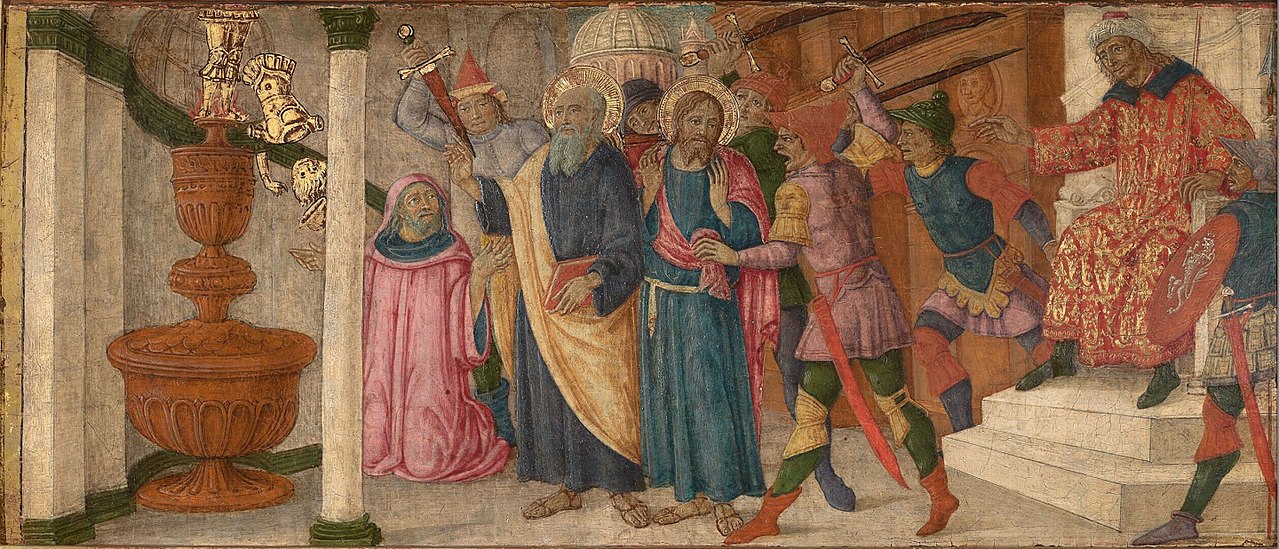
Guidoccio Cozzarelli’s greatness derives from eclecticism and the spirit of humanity that saturate his paintings. Cozzarelli’s historical works possess a passionate exuberance, bursting with dramatic details. His energetic style generated steady lucrative commissions throughout his painting career. He is considered one the greatest Renaissance painters of all time.
The newly emerging painting techniques and styles were a reflection of the transformation that was taking place in Europe, the change from the medieval period to a more enlightened, tolerant society. According to Historian Hendrik van Loon, “People were tremendously alive. Great states were being founded. Large centres of commerce were being developed. High above the turreted towers of the castle and the peaked roof of the town-hall, rose the slender spire of the newly built Gothic cathedral. Everywhere the world was in motion. The high and mighty gentlemen of the city-hall, who had just become conscious of their own strength (by way of their recently acquired riches) were struggling for more power with their feudal masters.
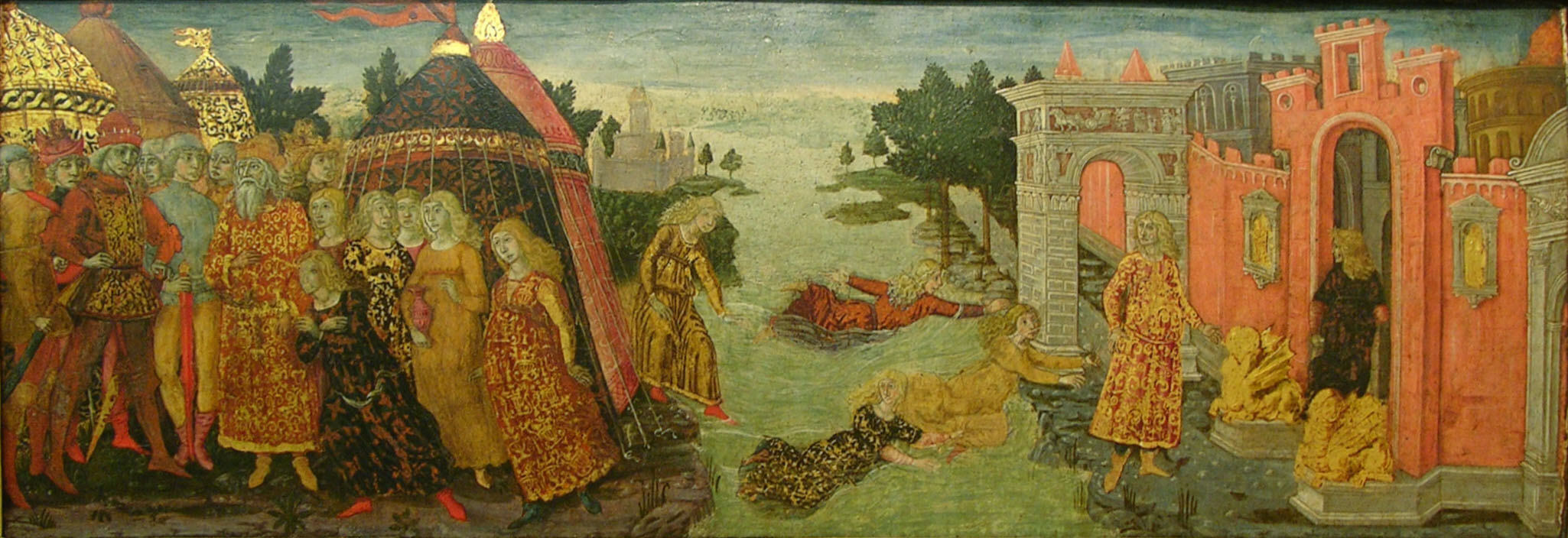
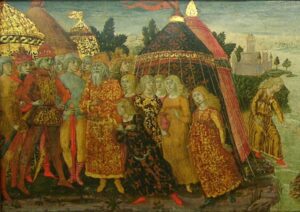
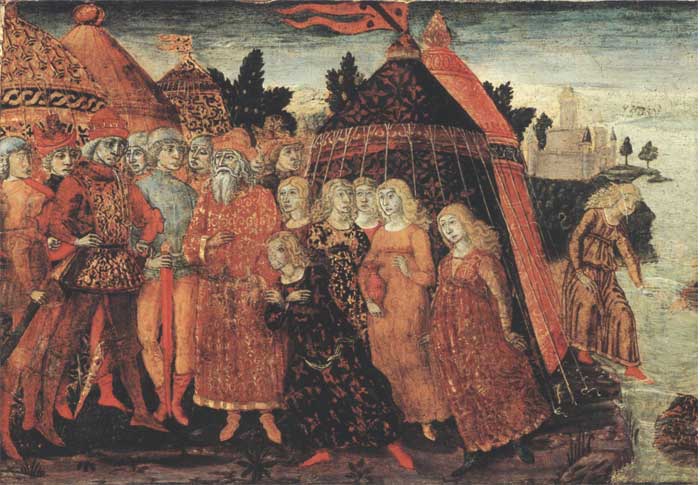
The Legend of Cloelia, ca. 1480
 During the early fifteenth century, Europe continued to evolve out of a series of medieval feudal states ruled by wealthy landowners into concentrated town centers or cities functioning as powerful economic nuclei. As these cities took on greater political and financial authority, the middle classes, made up of artisans, bankers, and merchants, played more substantial roles in commerce with their greater wealth and independence. Along with this prosperity, particularly marked in Italy, an increased number of palaces and villas were constructed, subsequently creating a greater demand for extravagant furniture and domestic art, both for established aristocratic patrons and the newly wealthy. (…) The manufacture of secular art objects, usually for the purpose of commemoration, personalized these lavish Italian Renaissance interiors. Because childbirth and marriage were richly celebrated, a number of objects were made in honor of these rituals.
 The wooden birth tray, or desco da parto, played a utilitarian as well as celebratory role in commemorating a child’s birth. It was covered with a special cloth to function as a service tray for the mother during confinement and later displayed on the wall as a memento of the special occasion. A desco da parto was usually painted with mythological, classical, or literary themes, as well as scenes of domesticity. The reverse often displayed a family crest. In some cases, a birth tray was purchased already painted, but custom-decorated with heraldry that personalized what might otherwise be a line item from a shop.
 The Legend of Cloelia
Cloelia was one of ten daughters and ten sons of Roman nobility who were given as hostages by the Roman consul Publicola to the Etruscan king Lars Porsena, as a token of good faith following the conclusion of a treaty between the Romans and the Etruscans. Cloelia led an escape by crossing the Tiber river on horseback and persuading her female companions to swim after her. Publicola returned the girls to the Etruscans, but Porsena, in admiration of Cloelia’s courage, presented her with a horse, and freed her and some of her companions. The story of Cloelia is recounted by Plutarch (“Life of Publicola,” XIX).
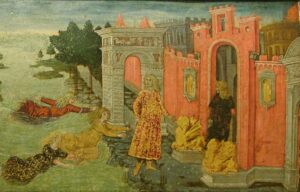
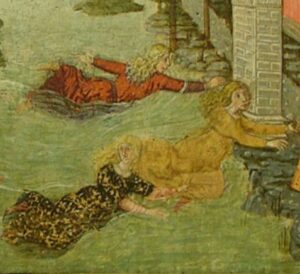
This painting depicts the girls swimming across the Tiber in the center and arriving at the gate of Rome on the right. At the left Publicola returns them to the Etruscan camp and Cloelia kneels before Porsena.
The Annunciation and the Journey to Bethlehem
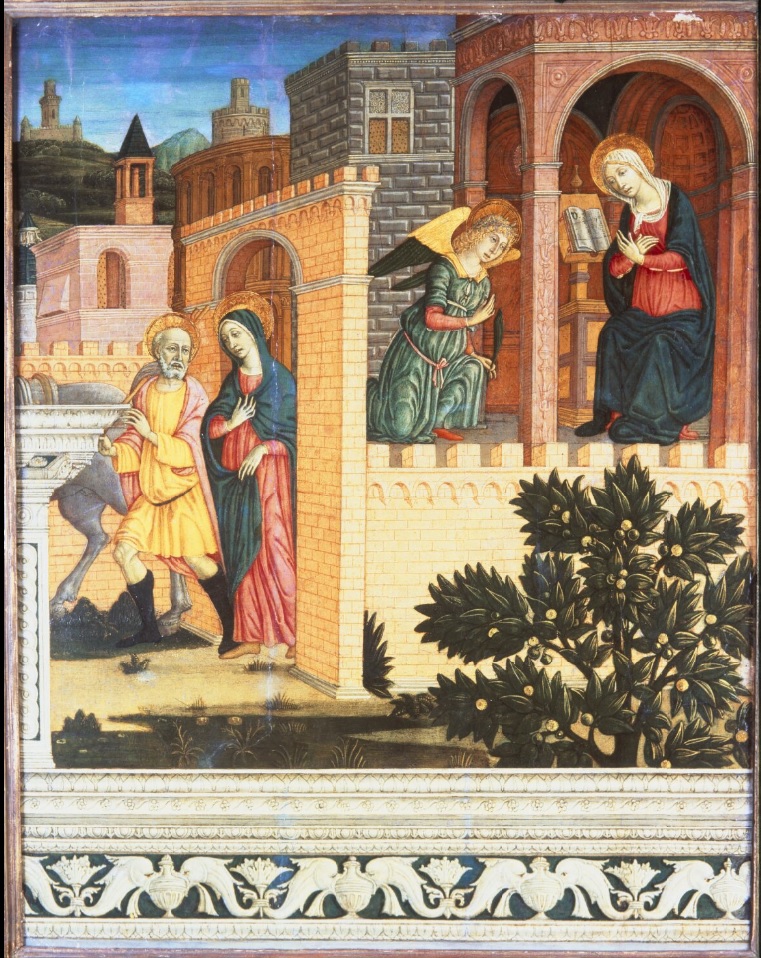
The Annunciation and the Journey to Bethlehem originally formed the upper right-hand corner of a large altarpiece, the exact format of which is unknown. The two scenes were part of the series illustrating either the infancy of Christ or the life of the Virgin, which may have served as the backdrop to an image of the Madonna and Child Enthroned; in that case, the cornice and pilaster at the far left of the panel may have been part of the Virgin’s throne. However, it is more likely that the foreground of the picture was occupied by a scene of the Nativity. This is suggested by the lower edge of the classical entablature, which, before it was partially repainted by an overzealous restorer, appeared as a ruin. The works of Cozzarelli, a painter of miniatures, altarpieces, and cassone panels (secular paintings used to decorate furniture), are frequently confused with those of his presumed master, Matteo di Giovanni (active 1452-1495). The format of Cozzarelli’s paintings and his feeling for decorative detail and textural richness are in the Sienese stylistic tradition, but his interest in perspective, naturalistic movement, classical architecture, and antique ornamentation reflects the significant influence of contemporary Florentine art.
Source: travelingintuscany.com