During the summer of 1856, photographer Gustave Le Gray (1820-1884) made several portraits of the Empress Eugenie at the Palace of Saint-Cloud; she had given birth to the Prince Imperial a few months earlier (on 16 March). The idea behind the photos was to assist fellow artist Thomas Couture (1815-1879) in his composition of a large-format representation of the baptism of the heir to the Napoleonic throne. Working from the photographs would enable Couture to paint the young mother kneeling without her actually having to hold the pose for many long hours.
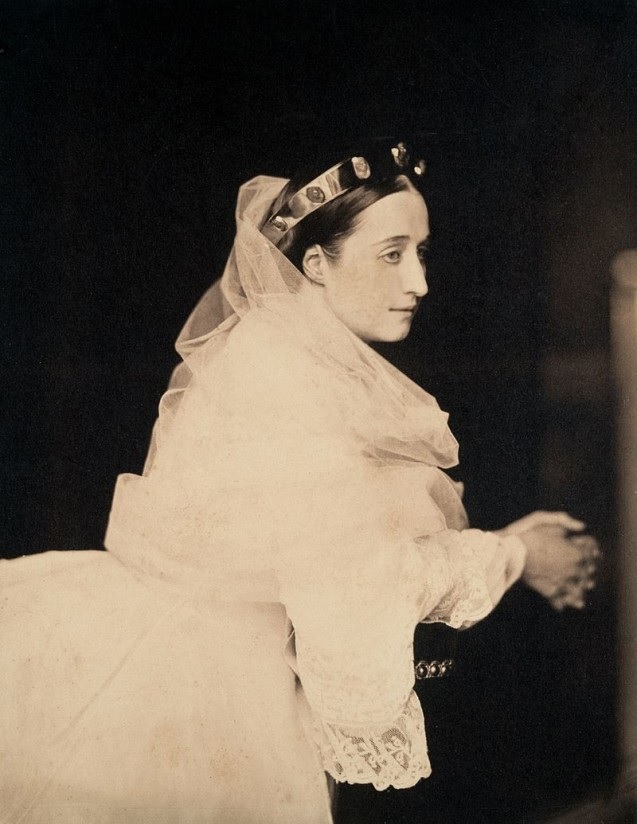
The Empress at prayer
At the special request of Couture, Le Gray composed several portraits of the Empress at prayer, varying the perspective, the pose, and the accessories as she knelt on a prie-dieu. In this profile portrait, the Empress’s face appears as if she were emerging from a spiritual meditation. She is clad in the white dress with lace sleeves that she wore during the ceremony and a white veil (probably tulle), pinned into her hair held-back, falls to her shoulders convering them. With her gentle gaze and expressionless face, the Empress seems to transcend her surroundings, lost in thought, offering the viewer a moment of intimacy.
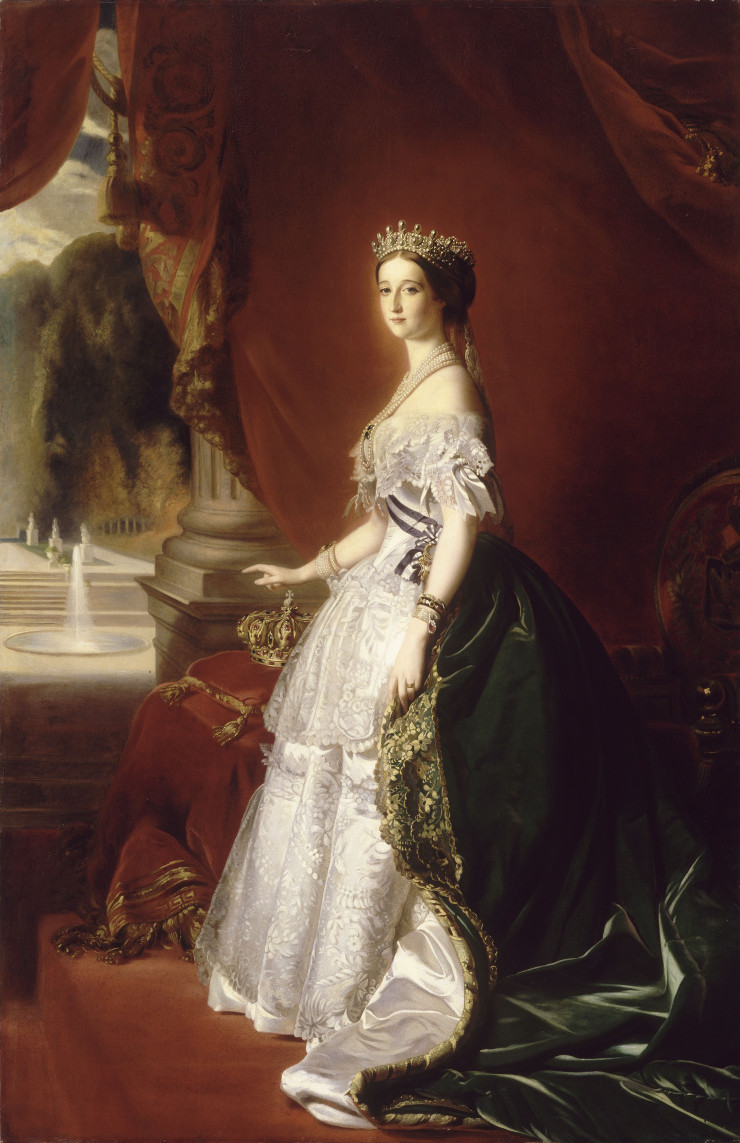
The only jewellery that the Empress appears to be wearing is a tiara, the very same which figures in a little-known painted portrait of the Empress by Le Gray executed in Cairo in 1869 on a commission by Isma’il Pacha, the Khedive of Egypt.
This link leads to an HD image which allows you to zoom in on the face, the lace, the tiara, and the armrest of the prie-dieu.
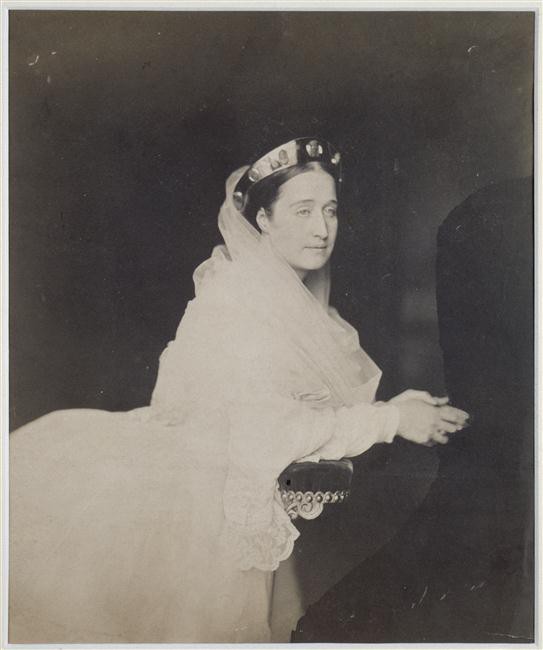
The Domaine National du Château de Compiègne possesses a similar photo taken at a slightly different angle:
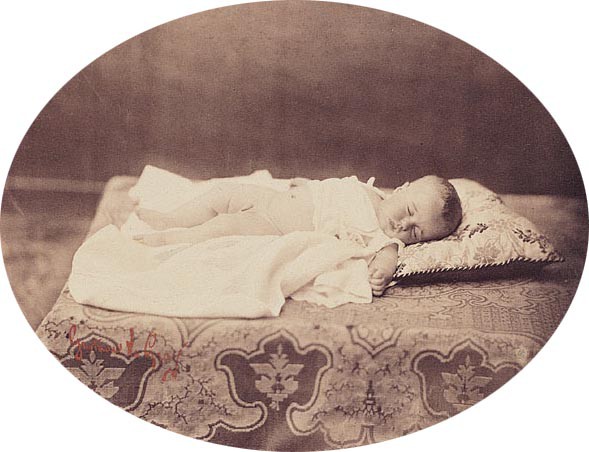
In 1996, the Bibliothèque Nationale de France (National Library of France) acquired a rare portrait of the Prince Imperial, taken in the summer of 1856 by Le Gray, very probably for Thomas Couture.
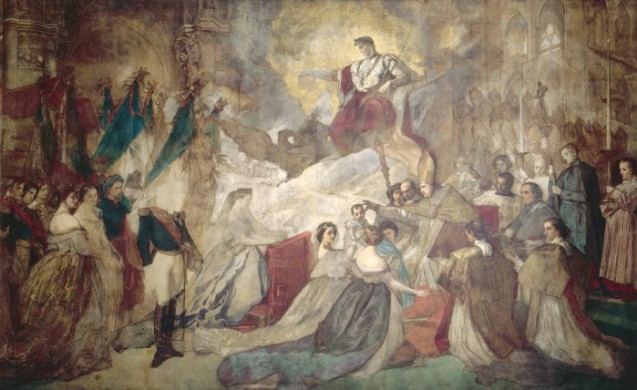
Thomas Couture’s relations with the authorities were to become difficult and he was never in fact to finish the painting celebrating the Baptism of the Prince Imperial, a work which was supposed to do for the image of the Second Empire what David’s painting of the Sacre de Napoléon [Napoleon’s coronation and consecration] had done for that of the First. All that remains of Couture’s planned work are the sketches held at the Château de Compiègne, along with thirteen painted studies and forty preparatory drawings. Couture’s painting was to highlight the fragility of the powerful by emphasising the Empress’s maternity in a poetical vision that brings the viewer into emotional proximity (see his work ‘Méthode et entretiens d’atelier’, 1867, available on Gallica, in French).
Gustave Le Gray, a master of photography
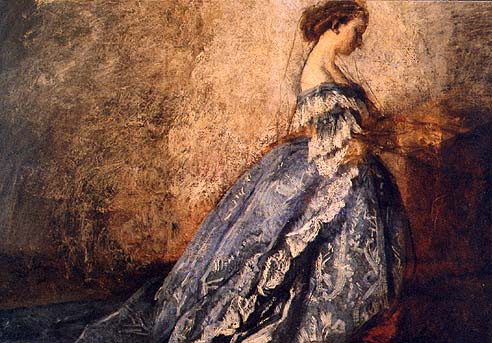
By 1856, Gustave Le Gray was already a celebrated master in the art of photography. His contemporaries included Nadar, Charles Nègre, Henri le Secq, and Édouard Denis Baldus. After a four-year period in Italy starting in 1844 studying painting, during which he married Palmira Leonardi (photo), (see here the portrait he painted of her in 1853). Le Gray returned to Paris in 1848. It was shortly afterwards in 1850 that Le Gray invented the negative on collodion glass (allowing camera shots in natural light and a shorter exposure time). The following year, he made more improvements inventing the waxed paper negative process. Le Gray in fact summed up his own talents, not only as an inventor but also as an artist in 1852 with the prophetic words: “photography, instead of merely remaining in the domain of industry and commerce, is entering the world of art.” He subsequently set himself up as a ‘photographiste’ (French neologism for photographer), whereby his studio at the Barrière de Clichy became a melting pot of photographic experimentation and exchange.
In 1851, Le Gray was asked to take photographs of the Salons des Beaux-Arts and also travelled around France as part of the ‘Mission Héliographique’ (Heliographic Mission) which was a large photographic campaign to record and preserve French heritage.
In 1854, he was instrumental in the Société Héliographique (created in 1851) being reformed as the Société Française de Photographie.
In 1852, Le Gray took the first ever official photo of the Prince President of the 2nd Republic, Louis-Napoleon Bonaparte. As a result of this success, the artist received many more prestigious commissions, notably a photo reportage in 1865 of the Military Camp at Châlons (see our Special Dossier). Le Gray’s talent was also recognised overseas, evident from 1851 during the Great Exhibition, London, then in the subsequent years in various UK towns and at the Royal Photographic Society, London.
As a result of financial difficulties, Le Gray was forced to sell his studio at 35 Boulevard des Capucines in 1860, where the great-and-the-good in Paris – and even further afield – had either posed or been introduced to photography. Still riddled with debts, the photographer left the same year with Alexandre Dumas on a Mediterranean cruise to do a reportage in Sicily. He fell out with the writer and decided to extend his trip to the East, to Lebanon and Alexandria in Egypt. In fact, Le Gray never returned to Europe, leaving behind his wife, Palmira, and his two surviving sons (out of seven), Auguste (born in 1851) and Eugène (born in 1857). After Alexandria, Le Gray moved to Cairo in 1864, where he was a professor of drawing at the military school. He died in the Egyptian capital in 1884. According to the English photographer Ludovico Wolfgang Hart (1836-1919), who visited him in Cairo, Le Gray devoted himself more to painting during his final years.
In fact, Le Gray had been a prolific painter studying under Paul Delaroche (1797-1856) and his pictural oeuvre is largely still today unknown. A master of both portraiture and landscape, Le Gray expressed himself as much inside his studio as he did outside it. His legacy includes several hundred photographs, whose particular qualities (perspective, light, “pictural” composition) were recognised at the end of the 1980s, so much so that his works have become highly sought after. His seascape ‘La Grande Vague, Sète’ (photo) fetched over 5 million francs in 1999 (Sotheby’s, Paris; the equivalent of over 980,000 euros in 2017), thereby breaking a record for a photograph at auction.
Irène Delage, December 2018
(English translation by R.J and RY)
Source: Fondation Napoléon