
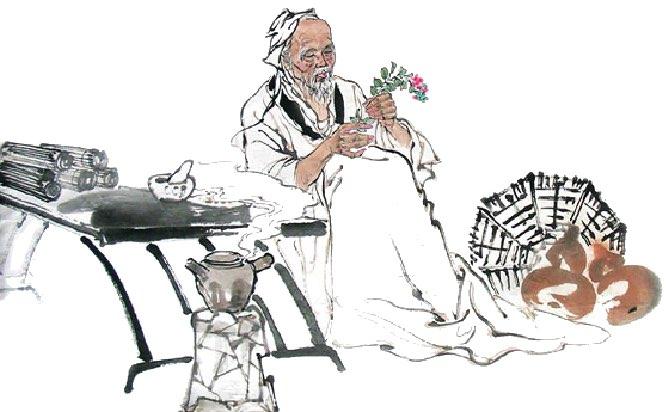
Painting depicts the scene of Sun Simiao, one of the great medical sages in Chinese history inspecting Chinese herb plants. He composed books with over 7,300 herb medicines.
Both Western and Chinese medicine deals with the diagnosis and treatment of illnesses related to organs.
Is the heart viewed the same in Western medicine as the heart in Chinese medicine? What about the other organs?
In as early as the Han Dynasty (206 B.C.–A.D. 220), the philosophical thinking of a divine force that “unites heaven and mankind” led to the belief that the human body not only corresponds to, but also communicates with our mother nature and the universe. The understanding of the human body differs drastically when comparing it to the view of that in the West.
Basic human anatomy is not neglected in Chinese medicine, as evidenced in the Huangdi Neijing, or the Yellow Emperor’s Inner Canon which also studied anatomy through dissecting cadavers. But, what traditional Chinese medicine emphasizes is the study of the functions of our internal organs which is not based on their anatomy. The following is a brief introduction and comparison of the concept of internal organs in Chinese and Western medicine.
Heart, Liver, Kidney, Spleen, and Lungs
In traditional Chinese medicine, the heart governs the spirit, willpower, and the blood; thus, in ancient Chinese works we rarely find terms such as brainstorm or state of mind, but terms such as heart-thinking or the state of heart. In modern Western medicine, the heart’s primary function is circulation. Anatomy swill how the heart as a mere blood pump. In this regard, the connection between the heart and human mental activities are unthinkable and inconceivable in the Western view of the human body. Yet, some heart transplant recipients have changed their personalities, habits, and even ways of thinking into those of the organ donors. This phenomenon indicates that the traditional Chinese theory on the heart does have merits, though it is beyond the understanding of modern medicine. How did the ancient Chinese discover that the heart governs one’s personality, spirit, and will?
In Chinese medicine, the liver governs the blending and channeling of the qi, known as the intrinsic life energy. The liver stores blood and determines one’s emotions and feelings at a certain time. The energy flow through the tendons (or jin) is controlled by the liver too. Its energy opens up at the eyes. Therefore, to treat depression, eye-related illnesses, and nail abnormalities (nails are believed to belong to the tendons by traditional Chinese medicine) one should examine the liver first. In modern Western medicine, the liver is just an organ for digestion, detoxification, and secretion of bile, and it is described to be a chemical plant inside the body. Thus, some of the chemical components of modern Western medicine damage the liver.
The kidney under the traditional Chinese medical systems is believed to be the foundation of prenatal constitution. It stores the life essence acquired from one’s parents and from the universe. The kidney is also in charge of human sexual and reproductive functions. Moreover, the energy from the kidney governs marrow and bones, and opens up at the ear. Hence, it relates closely to male impotency, infertility, tinnitus, hearing loss, and arthritics. While in modern Western medicine, the kidney is merely an excretory organ; it secretes urine and adrenaline which secretes testosterone.
The spleen is believed to be the foundation of a person’s post-natal constitution; it governs the digestion and the transformation of the essence of food and water one takes in. Specifically, the spleen grinds the foods down, refines them into nutrition and energy. It then transports them to different parts of the body. Hence the spleen governs the four limbs and the muscles. Its energy flow opens up at the mouth. Thus, the condition of the spleen should be taken into consideration when treating muscular atrophy, myasthenia gravis, and loss of taste. This understanding differs greatly from modern Western medicine, which views the spleen as part of the human body’s immune system—producing white blood cells to battle bacteria and viruses that have entered the body.
Both Western and Chinese medicine believe that the lung is an organ that governs breathing. Ancient Chinese doctors believed that the lung also governs the qi’s ability to elevate and descend as well as regulates its circulation around the body. Moreover, the lung also governs the hair and skin, and opens at the nose. Therefore, treating skin and nose abnormalities requires first treating the lung.
Of course, there are also the concepts and functions of the stomach, intestines, bladder, gallbladder, and other organs in which Western and Chinese medicine take very different points of view. They will be discussed in future articles.
Contrast of Ancient Chinese Medicine and Modern Western Medicine
From the above description, we can see that the theories of Chinese and Western medicines contrast greatly in regards to the understanding of human organs. The concept of an organ in Western medicine is the anatomical result of the real substance of the organ. The study of the organs’ functions is based on the logical analysis of their anatomy, an approach that is identical to all modern scientific methodology.
In Chinese medicine, the concept of an organ goes beyond the organ’s anatomy. Rather, it puts emphasis on the human body’s functions and their relationship with the other organs. Chinese medicine divides the human body’s functions into different systems that correspond to different organs. The study of functions is rooted in traditional Chinese philosophy and Taoist cultivation theory. They belong to a fundamentally different life-science system.
For example, in Chinese medical theories, there is a saying that the liver on the left and the lung on the right. A lot of people would say that this is scientifically untrue, because the basic anatomical location of the organs is wrong. But although Chinese medicine puts less emphasis on anatomy, it would not have mistaken the fact that the lung has two pulmonary lobes, one on the left and the other on the right side of the chest. But why would traditional Chinese medicine consider that both lobes are on the right? Actually, what the saying really means is that the liver and the lung are opposite in qi’s vertical circulation. Thus, the liver governs the upward movement of qi, and upward is always yang in nature. In Chinese philosophy, left is Yang; thus, the liver is considered to be on the left side. Similarly, the lung governs qi’s downward movement. Since downward is yin in nature, and the right side is considered yin, the lung is viewed at being on the right side.
If a Chinese medical doctor in today’s China tells a patient the diagnosis of a liver problem, he may not understand it, especially if the physical examination of the liver shows nothing wrong. Nowadays most Chinese people do not understand traditional Chinese medicine anymore. This system of medicine had been nearly eradicated due to the communist government’s attempt to destroy true Chinese culture. The emphasis was then placed on Western medicine and modern scientific principles and methodologies.
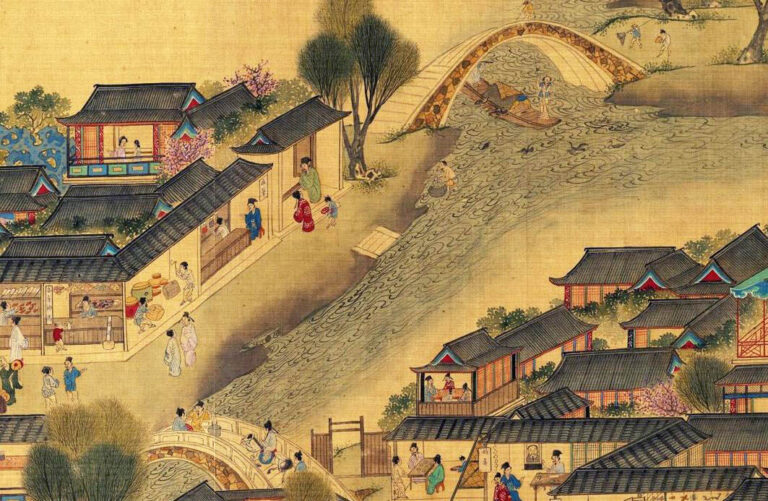
Judging Chinese medicine by modern Western medicine standards resembles judging Chinese paintings by renaissance-style Western oil painting’s standards of realism with the painters use of light contrast, proportion, focus, and perspective. Western paintings show the spirit of the objects by their realistic forms, while Chinese painting express the spirit directly and thus place less importance on whether the objects are depicted in their realistic forms. They are just two different systems of art; one should not use one system to criticize the other. Similarly, this is also true for the two systems of traditional Chinese medicine and modern Western medicine.
Some people often mock how shallow Chinese medicine is, but an increasing body of evidence from scientific research confirms what is truly shallow is our mockery. Rooted in ancient culture, traditional Chinese medicine has formed a complete and unique system of thinking. We may not fully understand this system yet. Mounting evidence has prompted us to review this ancient culture as well as the enlightenment and wisdom embodied therein.





















2 Responses