Scientists at Harvard Medical School and Boston University Chobanian & Avedisian School of Medicine have mapped a critical component of the Nipah virus, a highly lethal bat-borne pathogen that has caused outbreaks in humans almost every year since it was identified in 1999.
The advance, described Jan. 20 in Cell, brings scientists a step closer to developing much-needed medicines. Currently, there are no vaccines to prevent or mitigate infection with the Nipah virus and no effective treatments for the disease other than supportive care.
The virus, harbored by fruit bats, can be transmitted to pigs and to humans. It can also infect people through contaminated food and can travel directly from person to person via droplets released when coughing. The World Health Organization has declared Nipah virus a priority pathogen, a designation given to organisms that can cause serious outbreaks and require urgent research to inform prevention and treatment strategies.
Nipah virus has the potential to ignite a pandemic, researchers say, because it can spread via airborne droplets and respiratory secretions. Additionally, the researchers note, evidence hints that some infected people who develop milder, nonspecific symptoms may still transmit the virus.
In severe cases, the infection can cause serious respiratory illness and encephalitis, a form of brain inflammation that can lead to devastating neurologic deficits and death. The virus kills between 40 and 75 percent of those infected, according to estimates from the Centers for Disease Control and Prevention. By comparison, Ebola virus kills between 25 and 90 percent of those infected in past outbreaks, with an average death rate of 50 percent.
In the new study, researchers homed in on a part of the viral machinery called the viral polymerase complex, a group of proteins the virus uses to copy its genetic material, spread, and infect cells. The work provides a detailed three-dimensional picture of the virus’s polymerase and its key features. Understanding the structure and behavior of this critical piece of the viral machinery illuminates how the pathogen multiplies inside its hosts.
Until now, the structure and function of the Nipah virus polymerase remained poorly understood, researchers said, cautioning that further research would be needed to fully understand how the polymerase makes the different types of genetic materials that enable the virus to multiply.
Nonetheless, the team said, unraveling this piece of the viral apparatus is the critical first step toward profiling the inner workings of a virus that poses a serious threat.
“Identifying how the polymerase is regulated to switch on and switch off the different enzymatic activities that are required for viral replication would be game-changing, and this study represents a key step towards that goal,” said study co-corresponding author Rachel Fearns, Chair and Ernest Barsamian Professor of Virology, Immunology & Microbiology at the Boston University Chobanian & Avedisian School of Medicine.
Unraveling the molecular structure of the viral polymerase complex provides a foundation that can inform the design of treatments.
“This new understanding can help us identify the functional properties of the polymerase structure that could be leveraged as drug targets,” said co-corresponding author Jonathan Abraham, associate professor of microbiology in the Blavatnik Institute at Harvard Medical School and an investigator of the Howard Hughes Medical Institute.
Once the researchers worked out the structure of the enzyme, they took a closer look at how different parts of the enzyme affect the different functions that it performs. Understanding the roles of these different parts and how they can adopt different positions offers critical clues for how to block the virus’s proliferation.
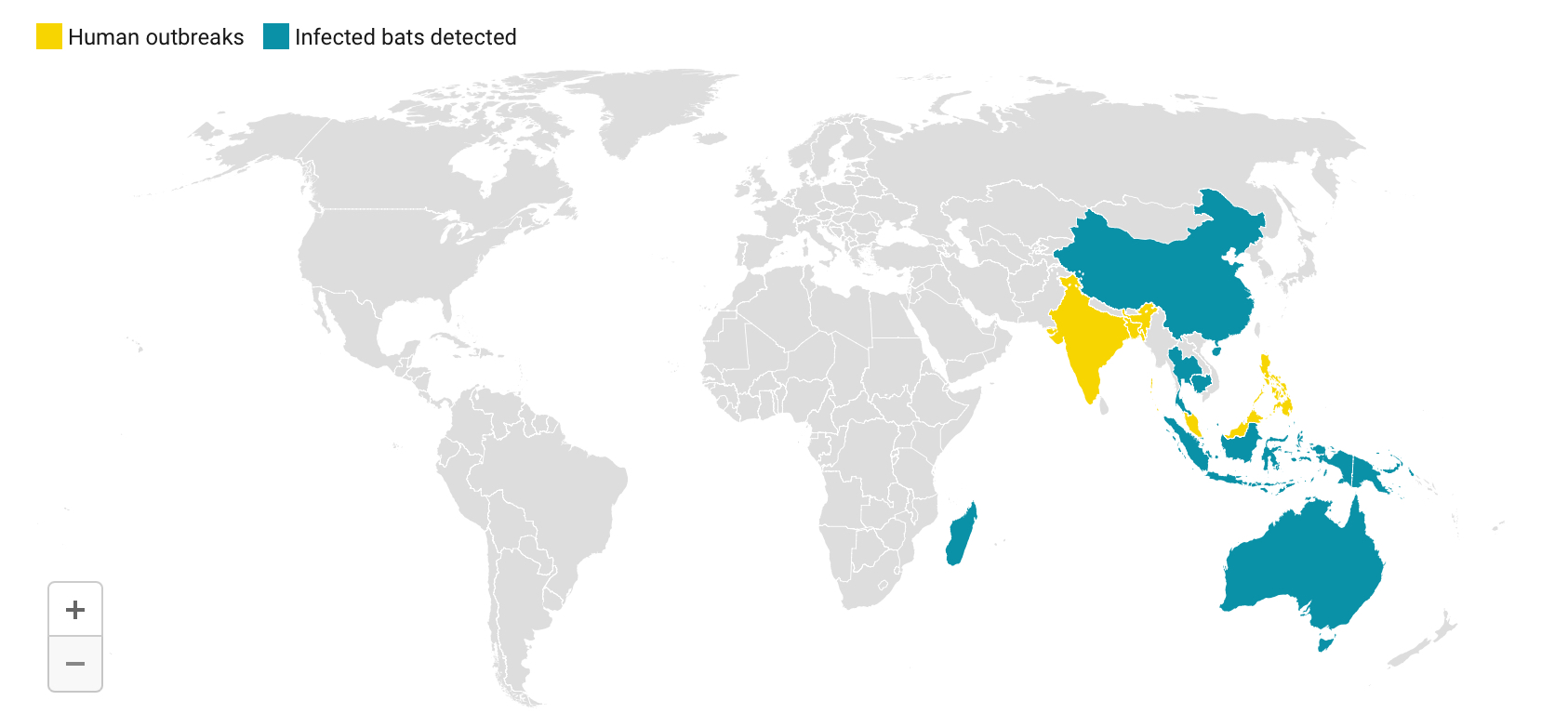
Where Nipah virus has struck
Localized Nipah virus outbreaks among people have been reported in Bangladesh, India, Malaysia, Philippines, and Singapore. Bats infected with the Nipah virus and closely related viruses, including the deadly Hendra virus, have been found in Australia, Bangladesh, Cambodia, China, India, Indonesia, Madagascar, Malaysia, Papua New Guinea, Thailand, and Timor-Leste. The species of fruit bats that carry the virus are found throughout Asia, Oceania, and Africa.
The researchers conducted the experiments in two different ways. First, they purified the polymerase and determined its structure using cryo-electron microscopy, a technique that allows scientists to visualize the structure of biologic samples at the scale of individual molecules. Second, they induced mutations in the polymerase and then observed how the mutated polymerase behaved in cells to understand how these mutations affected its function.
“Elucidating both the unique and shared characteristics of the Nipah virus polymerases in comparison to other viral polymerases, our study provides critical insights that have the potential to inform the development of broad-spectrum antivirals,” said study co-first author Heesu Kim, a researcher in the Fearns Lab.
The researchers note that there is one promising oral drug candidate developed by scientists at Georgia State University that works against viruses related to Nipah but not against Nipah virus itself.
To understand why this drug candidate is ineffective against Nipah virus, the researchers conducted various simulation studies to see whether certain structural tweaks to the viral polymerase would improve the ability of the drug to latch onto the virus. The researchers identified a specific portion of the viral polymerase that could become a drug target. This in turn can inform the design of small-molecule inhibitors that disrupt the viral polymerase and render Nipah virus susceptible to treatment.
“We hope that our findings will spark interest and stimulate additional research by others, enabling new insights into a deadly pathogen,” said Side Hu, co-first author on the study and a postdoctoral researcher in the Abraham Lab. “Indeed, we were excited to see other groups share their data openly just as we did and help move the field forward.”