The Middle Land

3I/ATLAS: Alien or Comet?

The 3I/ATLAS Extraterritorial Sparks Speculations On Its Origins and Purpose

91 Views

By Akerele Christabel

Add Your Heading Text Here

Oumuamua appeared in 2017, without exhibiting the normal characteristics of a comet. It lacked a coma, dust or tail, looking like a giant cigar-shaped piece of rock floating in space. Borisov came into the scene two years later with all the features of a conventional comet. On 1st, July 2025, the interstellar trinity was completed when 3I/ATLAS tore into our solar system at a speed of 209,000 kilometers, making it the fastest of the trio. However, recent discoveries have led space experts to speculate wildly on the origins of the comet, with news of alien involvement afoot.

ATLAS (Asteroid Terrestrial-impact Last Alert System), a NASA-funded survey telescope in Rio Hurtado, Chile, was the first to report their observations of comet 3I/ATLAS on July 1, 2025. These observations were also corroborated by three other ATLAS telescopes on the planets. The comet was named after the ATLAS survey team, with the “I” standing for “interstellar”, and the “3” in its name saying the it is the third known interstellar object.

Comet 3I/ATLAS streaks across a dense star field in this image captured by the Gemini North telescope’s Gemini Multi-Object Spectrograph (GMOS-N). The left panel captures the comet’s colorful trail as it moves through the Solar System. The image was composed of exposures taken through three filters, shown here as red, green, and blue. (Photo: International Gemini Observatory/NOIRLab)

After the initial discovery of the comet, gears began to turn as space research companies began to wildly collect data. Unlike comets bound to the sun’s gravity, 3I/ATLAS is traveling on a hyperbolic orbit that will see it leave the solar system and travel again into interstellar space. This means there will be no return trip for the comet. Hence, the reason astronomers are scrambling to collect all the data they can get before the this comet formed by the components of another star system gets to the exit door of this solar system.

NASA’s Hubble Space Telescope previously got a look at the comet in July, collecting data that allowed astronomers to peg the size of the comet’s solid, icy nucleus between 1,000 feet and 3.5 miles wide. The James Webb Space Telescope then observed the interstellar object on August 6 in near-infrared light, followed by the newer SPHEREx telescope from Aug. 7-Aug. 15, to get a better idea of its physical properties and chemical makeup.
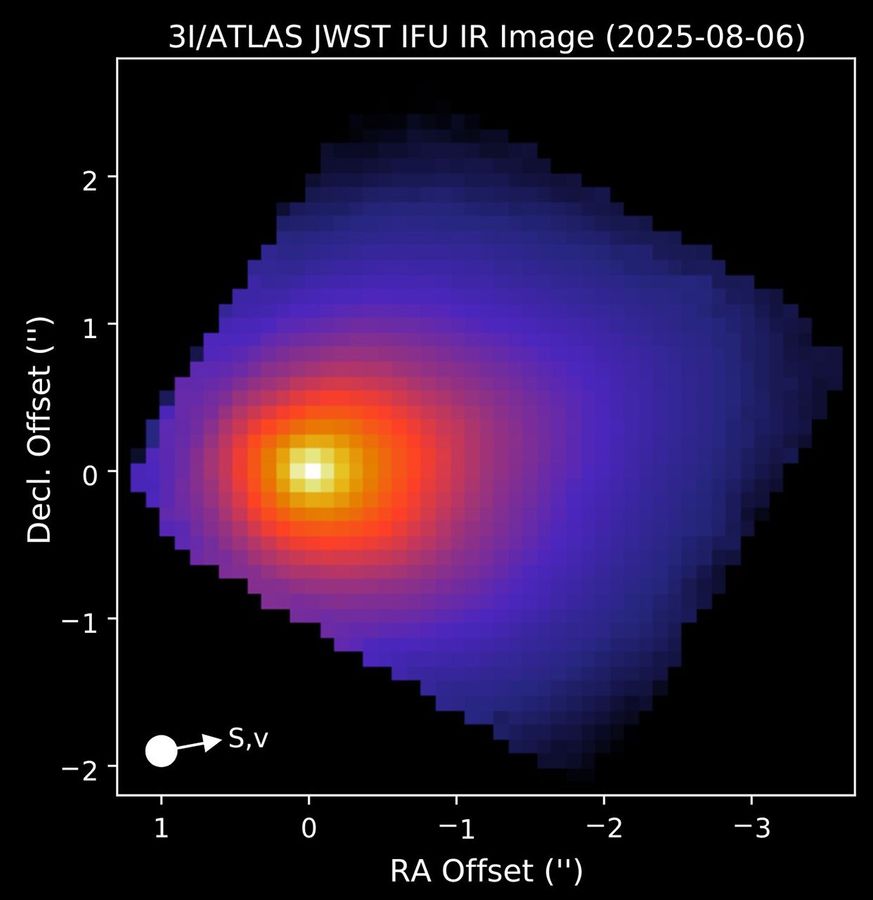
The interstellar invaded comet 3I/ATLAS seen by the infrared vision of the JWST. (Image credit: NASA/James Webb Space Telescope)

3I/ATLAS is expected to pass through the planet Mars on Friday, 3rd October, 2025. Researchers have anticipated this trajectory and have made ample preparations to collect data as the comet comes within 18,600 miles of Mars. Two Mars orbiters, Mars Express and ExoMars Trace Gas Orbiter, will be able to observe 3I/ATLAS until 7th of October. Then between 2nd and 25th of November, ESA’s Jupiter Icy Moons Explorer (Juice) will observe the comet with its instruments when the object is expected to be in a “very active state” following its closest approach to the sun.

Interstellar comet 3I/ATLAS photographed by the 8.2-meter Gemini South telescope on 27 August 2025 during 23:55-23:57 UTC. This is a median stack of two 30-second exposures; the combination of these images helps make the comet appear more clearly by reducing the visibility of image noise and cosmic rays. 3I/ATLAS appears as a bright fuzzy blob at the center, with a faint diffuse tail protruding from the left of the comet (away from the Sun). The image is oriented North up and East left. (Photo: Wikimedia Commons)


Wild Theories?

Due to its peculiarities, 3I/ATLAS has been at the center of several wild theories, with alien involvement being the core of such discussions. Avi Loeb, professor of science at Harvard, has been the loudest proponent of the alien story.

Avi Loeb (Photo: Jake Belcher)

In an interview with Newsmax’s “Wake Up America”, he posted that there were some anomalies about the comet, suggesting that there was a chance it could be alien technology. One of such anomalies Loeb pointed out was the size of the comet, which according to him was “at least five kilometers in diameter, but it could be up to a factor of 10 bigger than that. And the puzzle here is that it’s at least a thousand times more massive than the previous object, Borisov, which was a comet.”

“But then you ask yourself: How come the previous object was roughly a couple of times the size of a football field, and this one is of … Manhattan Island? There is also not enough rocky material in interstellar space to accommodate the delivery of a size roughly the size of a Manhattan Island once per decade. Now, in addition to that, its trajectory is aligned with the planet’s to within five degrees, and the chance of that happening at random is 1 in 500. So here is another anomaly. In addition, there was scattered light in front of the object 10 times longer than it is wide in the Hubble Space Telescope image. Usually, we see scattered light behind the object away from the sun, because dust particles are pushed away by radiation pressure from the sun.” Loeb added.

This artist’s concept shows how ‘Oumuamua is usually depicted: as a cigar shaped asteroid. (Photo: ©Planetfelicity/Dreamstime.com)

He believes these factors are reason enough for the world to keep its eyes on the object and study it while it is within range.

This will not be the first time Loeb has pinned the “alien technology” tag on extraterrestrial objects. In 2018, Loeb co-authored a study in The Astrophysical Journal Letters, investigating the potential origins of the Oumuamua in which the possibility that it is “of an artificial origin” was seriously considered.

Trajectory of the interstellar comet in the solar system. It will be visible on Earth on December 19. It has recently been reported that it survived a recent solar storm.


Loeb and his colleague wrote that ‘Oumuamua could possibly be something called a lightsail, the technology that uses light from the sun or other stars to push it through space.


Tag

SubscribeNewsletter@2x
Refreshing and Insights
at No Cost to You!

Cancel anytime

One of the most remarkable examples of medieval Chinese Buddhist art is

Back-to-back monster winters (1867 and 1868) paralyzed railroad construction over Donner Pass.

When a Speech Nearly Never Happened: The U.N. Session That Drew Unexpected

Margaret Thatcher (1925–2013), often remembered as the “Iron Lady,” remains one of

Art has the incredible power to evoke emotions, tell stories, and transport

“Painting has been my passion since childhood, and my parents were always

Curator Laura Llewellyn works with art handlers to arrange and hang a

A mother asks what she should say to her 9-year-old daughter who

Long before the rise of communism, photographers captured a China that few

Across the United States, some of the country’s most memorable destinations are

The Eiffel Tower in Paris. The Clock Tower of London. The Busy

Small old villages in United Kingdom are known for their historic charm,

From distant worlds at the edge of the Solar System to colossal

The Eiffel Tower in Paris. The Clock Tower of London. The Busy

The universe is far stranger — and more beautiful — than imagination

In what would have marked Queen Elizabeth II’s 100th birthday, King Charles

Did Ancient China Discover America Before Columbus?

A Former Flight Attendant Recounts Tiananmen Massacre in Beijing (Audio)

The Iron Lady’s Secret: Margaret Thatcher Leadership Advice

When Poetry Becomes a Cry of the Soul: The Meaning of “Un dì all’azzurro spazio” — and Franco Corelli’s Legendary Performance

What did a modern kitchen look like in the early 1950s? A

Let us take the three worst and most striking characteristics, patience, indifference

Psychology says the 1960s and 70s accidentally produced one of the most

I. Mellowness “CHARACTER” is a typically English word. Apart from the English,

In the dimly lit hall of the Stanton Center in Monterey, CA,

Margaret Thatcher (1925–2013), often remembered as the “Iron Lady,” remains one of

Few events of the late 20th century continue to provoke as much

[totalpoll id="62479"]
Cancel anytime

Contact us

The Middle Land

100 Wilshire Blvd., Suite 700 Santa Monica, CA 90401

Login Now

Sign in to your account

Don’t have an account? Sign Up

Don't have an account?

Sign up

Receive free monthly subscription & other benefits

Already have an account? Sign in

Already have an account?

To Editor

One of the most remarkable examples of medieval Chinese Buddhist art is

Back-to-back monster winters (1867 and 1868) paralyzed railroad construction over Donner Pass.

When a Speech Nearly Never Happened: The U.N. Session That Drew Unexpected

Margaret Thatcher (1925–2013), often remembered as the “Iron Lady,” remains one of

Art has the incredible power to evoke emotions, tell stories, and transport

“Painting has been my passion since childhood, and my parents were always

Curator Laura Llewellyn works with art handlers to arrange and hang a

A mother asks what she should say to her 9-year-old daughter who

Long before the rise of communism, photographers captured a China that few

Across the United States, some of the country’s most memorable destinations are

The Eiffel Tower in Paris. The Clock Tower of London. The Busy

Small old villages in United Kingdom are known for their historic charm,

From distant worlds at the edge of the Solar System to colossal

The Eiffel Tower in Paris. The Clock Tower of London. The Busy

The universe is far stranger — and more beautiful — than imagination

In what would have marked Queen Elizabeth II’s 100th birthday, King Charles

Did Ancient China Discover America Before Columbus?

A Former Flight Attendant Recounts Tiananmen Massacre in Beijing (Audio)

The Iron Lady’s Secret: Margaret Thatcher Leadership Advice

When Poetry Becomes a Cry of the Soul: The Meaning of “Un dì all’azzurro spazio” — and Franco Corelli’s Legendary Performance

What did a modern kitchen look like in the early 1950s? A

Let us take the three worst and most striking characteristics, patience, indifference

Psychology says the 1960s and 70s accidentally produced one of the most

I. Mellowness “CHARACTER” is a typically English word. Apart from the English,

In the dimly lit hall of the Stanton Center in Monterey, CA,

Margaret Thatcher (1925–2013), often remembered as the “Iron Lady,” remains one of

Few events of the late 20th century continue to provoke as much

Forget Password

Please enter your email id or user name to recover your password
[reset_password]

Login to Vote!

Thank you for your participation, please Log in or Sign up to Vote

Don’t have an account?

Login to Comment

Thank you for your participation, please Log in or Sign up to Comment
Forgot Password?

Don't have an account?

Thank you for your subscription!